Category: Economy & Cost of Living

  • You Can’t Afford a House

    You Can’t Afford a House

    He’s Using Housing as a Bargaining Chip

    Millions of Americans are getting crushed by housing costs.

    Rent is too high.

    Mortgage payments are too high.

    Starter homes are disappearing.

    Big investors are buying up neighborhoods like houses are Pokémon cards.

    Young families are realizing the math isn’t mathing.

    And then…

    A miracle.

    Congress actually agreed on something.

    Not a little something.

    A real bipartisan housing bill.

    The 21st Century ROAD to Housing Act passed the Senate 85-5 and the House 358-32.

    That isn’t “barely passed.

    That’s Congress practically shouting, “We have a housing crisis. Let’s do something.”

    And then Donald Trump refused to sign it.

    Not because the bill was too expensive.

    Not because it wouldn’t work.

    Not because he suddenly developed a passion for housing policy somewhere between another round of golf and apparently falling asleep at the G7 Summit.

    I guess “Sleepy Joe” wasn’t a diagnosis. It was projection.

    No.

    He refused to sign it unless Congress first passed his unrelated SAVE Act.

    Housing.

    For voting.

    Because apparently if millions of Americans need help buying or renting a home, that’s just another bargaining chip.

    What in the flip?

    Here’s What He’s Holding Hostage

    Whether you’re a renter, a first-time homebuyer, a veteran, or just wondering why your kids can’t afford to move out — this bill was written with you in mind.

    This bill won’t solve the housing crisis overnight.

    Nobody claims it will.

    But it would actually move the ball in the right direction.

    It helps communities build more housing.

    Because when there aren’t enough homes, prices go up.

    This isn’t complicated.

    It cracks down on large investors buying thousands of single-family homes that should be available to families trying to buy their first house.

    It helps convert vacant office buildings into housing instead of letting them sit empty while people struggle to find somewhere they can afford to live.

    It expands manufactured and modular housing, making it easier to build quality homes faster and at lower cost.

    It supports veterans, rural communities, affordable housing initiatives, and programs designed to help increase the housing supply.

    In other words…

    It actually tries to do something.

    Imagine that!

    This Is Why People Hate Politics

    This is the part that drives people crazy.

    When Congress actually works together…

    When Republicans and Democrats agree on something.

    When they finally pass legislation that could HELP ordinary Americans…

    Washington decides to use it as leverage for something completely unrelated.

    Not because the housing bill is bad.

    Not because families don’t need homes.

    Not because veterans don’t deserve affordable housing.

    Because — well, politics.

    Meanwhile, first-time buyers are giving up.

    Renters are paying half their paycheck just to keep a roof over their heads.

    Young adults are moving back in with their parents because buying a starter home has become a fantasy.

    And Washington is playing, “I’ll help you… if you give me what I want first.”

    Housing isn’t a poker chip.

    Families shouldn’t be collateral damage.

    And if Congress finally manages to pass something that might actually help people find a place to live????

    Sign the damn bill.

    Scarlett says no.


    Want to Read It Yourself?

    I always encourage people to verify what they’re reading—even when it’s me.
    Official Congressional Resources

    •  Bill Summary

    •  Full Bill Text⁠


  • Trump “Loves” Inflation

    Trump “Loves” Inflation

    While Families Pay 40.5% More for Gas

    Apparently, rising prices are delightful when you are not the person standing at the gas pump watching the numbers spin.

    Inflation climbed to 4.2% in May, the highest annual rate in three years. Prices rose another 0.5% in a single month. Energy costs increased 23.5% over the past year. Gasoline prices jumped 40.5%.

    And President Donald Trump’s response?

    “I love the inflation.”

    Yes. He actually said that.

    Trump later tried to explain that he believed the numbers were better than expected given the war with Iran. But ordinary people do not pay their bills with presidential spin. They pay them with actual money. And every dollar spent filling the tank is a dollar that cannot be spent on groceries, rent, childcare, medications, or the electric bill.

    Inflation Is Not an Abstract Number

    Inflation is often discussed as though it is a political scoreboard.

    It is not.

    It is the parent wondering whether the family can afford the summer road trip they already promised the kids.

    It is the worker whose commute suddenly costs substantially more, even though the paycheck did not magically grow with the gas bill.

    It is the small business owner paying more for deliveries and trying to decide whether to raise prices or absorb another hit.

    It is the retiree watching a fixed income stretch a little less every month.

    The latest government report shows that the pain is not limited to gasoline. Energy prices rose sharply in May, while shelter costs, airline fares, medical care, personal care, and recreation also increased. Food prices rose 3.1% over the past year.

    The Gas Pump Does Not Care About Political Excuses

    The White House argues that the rising costs are temporary disruptions related to the Iran conflict and that prices will fall when the situation is resolved. Perhaps they will. Families certainly hope so.

    But this administration does not get to treat a 40.5% increase in gasoline prices like an interesting little inconvenience.

    People remember being promised lower prices.

    They remember being told that affordability would improve.

    They remember hearing that everything would be fixed quickly and easily.

    Now they are being told to celebrate inflation because it could have been worse.

    That is not a solution. That is a shrug from people who do not feel the consequences the way ordinary families do.

    Read the Room

    A president saying that he “loves” inflation while millions of people are paying more for basic necessities is not merely a clumsy choice of words.

    It reveals a much larger problem.

    Too many powerful people experience economic pain as a press-conference question. Everyone else experiences it when the debit card is declined, when the credit-card balance grows, or when one more ordinary expense becomes something that has to wait until payday.

    Families are not asking for a victory lap.

    They are asking how they are supposed to absorb another round of rising prices.

    What in the flip?

  • The Generation War Is a Distraction

    The Generation War Is a Distraction

    Spend five minutes online and you’ll find someone blaming Boomers for everything.

    Housing prices.

    Student debt.

    Healthcare costs.

    Stagnant wages.

    Retirement insecurity.

    Climate change.

    Pick a problem and somewhere, someone is explaining why an entire generation is responsible.

    It’s a convenient story.

    It’s also a distraction.

    Most Boomers weren’t CEOs. They weren’t senators. They weren’t hedge fund managers, corporate lobbyists, or billionaires writing tax policy.

    They were teachers, mechanics, nurses, factory workers, office staff, firefighters, truck drivers, small business owners, and parents trying to keep food on the table.

    Just like most Millennials.

    Just like most Gen Xers.

    Just like most Gen Z workers today.

    The average person wasn’t sitting around in the 1970s plotting how to make housing unaffordable fifty years later.

    They were working.

    Raising families.

    Paying bills.

    Trying not to drown.

    That doesn’t mean mistakes weren’t made. Policies were passed. Industries changed. Wealth became increasingly concentrated. Labor protections weakened. Housing became an investment vehicle instead of simply a place to live.

    But those decisions weren’t made by millions of ordinary people acting in unison.

    They were made by people with power.

    And that’s where the conversation should be.

    Because while we’re busy arguing about whether Boomers ruined everything or whether younger generations are entitled, the people who actually shape the rules rarely face the same scrutiny.

    The generation war is useful because it redirects anger.

    Instead of asking why housing is increasingly unaffordable, people blame Boomers.

    Instead of asking why wages haven’t kept pace with productivity, people blame Millennials.

    Instead of asking why young adults are struggling to get established, people blame Gen Z.

    Everyone gets a villain.

    Nobody examines the system.

    The truth is that most Americans, regardless of age, have far more in common with one another than they do with the people making the biggest decisions.

    Most people want decent schools.

    Affordable housing.

    Accessible healthcare.

    Safe communities.

    A fair shot.

    The generations aren’t the enemy.

    They’re simply different groups of people trying to survive under the same set of rules.

    And the longer we spend fighting each other, the less likely we are to ask who benefits from the fight in the first place.

    Maybe that’s why the generation war never seems to end.

    It’s a remarkably effective distraction.

    Scarlett says follow the money.

  • The World Kept Traveling.

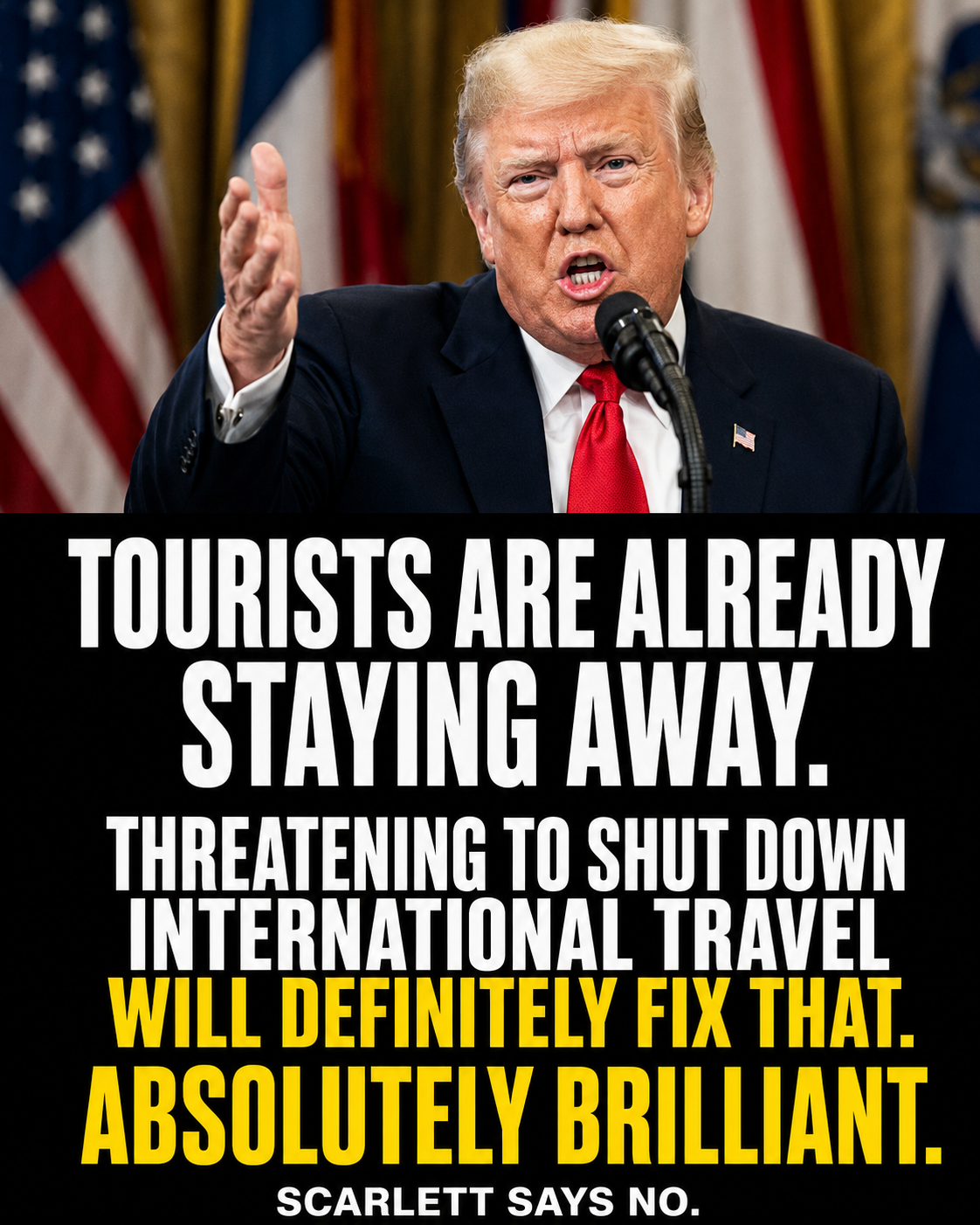
    The World Kept Traveling.

    Fewer people chose us


    The rest of the world kept traveling in 2025.

    Eighty million more people took international trips.

    But visits to the United States fell 5.5%.

    International visitor spending in the U.S. dropped 4.6% to $176 billion.

    Meanwhile, the global tourism industry had its best year ever, contributing a record $11.6 trillion to the global economy.

    The world moved forward.

    America went backward.

    What in the flipping hell is that?

    This Is Not Just About Vacations

    Tourism means jobs.

    It means hotel rooms, restaurant meals, museum tickets, local shops, rental cars, and money flowing into communities across the country.

    International travelers spend more, stay longer, and support businesses across the United States.

    When fewer people visit, American workers and small businesses pay the price.

    Hostility Is Not a Tourism Strategy

    Travelers have choices.

    They can spend their money somewhere that feels safer, calmer, and more welcoming.

    You cannot spend years treating outsiders like enemies and then act shocked when fewer people show up with suitcases and credit cards.

    That is not “America First.”

    That is self-sabotage wrapped in a flag.

    The world kept traveling.

    Fewer people chose us.

    Maybe it is time to ask why.

    Scarlett says no.