Category: Immigration & Civil Rights

  • Ron DeSantis Had a Billion Dollars ….

    Ron DeSantis Had a Billion Dollars ….

    He Just Didn’t Spend It on Floridians.

    Every year, Floridians are told to prepare.

    Prepare for another hurricane.

    Prepare for another insurance increase.

    Prepare for higher property taxes.

    Prepare for crowded classrooms.

    Prepare for another year of not being able to afford a home.

    Prepare to do more with less.

    Apparently, the only person in Florida who never has to prepare for a budget shortage is Ron DeSantis.

    Because when he wanted to build immigration detention camps, he somehow found nearly a billion dollars.

    According to a Miami Herald investigation, DeSantis’ administration signed at least 55 contracts worth roughly $1 billion to build and operate two state-run immigration detention facilities, including the Everglades camp his administration proudly called “Alligator Alcatraz.”

    A billion dollars.

    Think about that for a minute.

    A governor who says government spends too much…

    …spent a billion dollars building cages.

    And before anyone says, “Well, they were all dangerous criminals…”

    No.

    Reporting found that hundreds of people detained had no criminal charges. Some had pending asylum claims. Some were seeking lawful permanent residence. Many had jobs, spouses, children, and lives rooted in Florida.

    These weren’t strangers from some distant place.

    Some were Florida’s neighbors.

    Florida’s coworkers.

    Florida’s taxpayers.

    People who helped pay into the very system that ended up locking them behind its fences.

    Read that again.

    Florida taxpayers helped finance a detention system that could be used against other Florida taxpayers.

    If that doesn’t bother you, it should.

    Because history has taught us something over and over again.

    Governments don’t spend a billion dollars building detention systems because they expect to use them once.

    They build them because they plan to use them.

    Today it’s undocumented immigrants.

    Tomorrow it’s someone with Temporary Protected Status.

    Someone whose green card renewal is delayed.

    Someone with a pending asylum case.

    Someone who showed up for an immigration appointment believing they were following the rules.

    Every expansion of government power begins with the promise that it will only be used against those people.

    Until one day…

    Those people become your neighbors.

    Or your coworkers.

    Or your family.

    Or you.

    Meanwhile, back in the real Florida…

    Families are choosing between groceries and homeowners insurance.

    Teachers are buying school supplies with their own money.

    Young adults have given up on buying a home.

    Seniors are wondering how much longer they can afford to stay in theirs.

    Veterans wait for services.

    Communities brace for the next hurricane.

    And somehow we’re told there’s never enough money.

    Really?

    Because when Ron DeSantis wanted a headline, a billion dollars appeared out of thin air.

    Imagine if he’d shown the same urgency for lowering insurance premiums.

    Or making housing affordable.

    Or strengthening schools.

    Or helping communities recover after storms.

    Or fixing Florida’s crumbling infrastructure.

    Instead, Florida got Alligator Alcatraz—a political stunt with a billion-dollar price tag.

    One more thing.

    According to the Herald, one of the biggest winners wasn’t a construction company.

    It wasn’t an engineering firm.

    It wasn’t a hospital.

    It wasn’t emergency management.

    It was a portable toilet company.

    More than $219 million.

    For porta-potties.

    You really can’t make this stuff up.

    The question isn’t whether Florida had a billion dollars.

    It did.

    The question is what kind of governor looks at families struggling to insure their homes, teachers struggling to educate their students, seniors struggling to stay afloat… and decides the state’s biggest priority is building more places to lock people up.

    That’s not fiscal responsibility.

    That’s not leadership.

    That’s choosing political theater over the people you were elected to serve.

    Scarlett says no.

  • Haiti Is Too Dangerous for Americans

    Haiti Is Too Dangerous for Americans

    Why Is It Safe Enough to Deport Haitians?

    The Supreme Court just handed Donald Trump another immigration victory.

    Not because Haiti suddenly became safe.

    Not because Syria suddenly found peace.

    Not because the facts changed.

    Because six justices said the administration could move forward anyway.

    Hundreds of thousands of Haitians and thousands of Syrians who have been living and working here legally under Temporary Protected Status can now lose that protection.

    Let’s be clear about something.

    Temporary Protected Status wasn’t created to reward people.

    It exists because Congress recognized that sometimes sending people home means sending them into war, political collapse, natural disasters, or violence so severe that doing so would be unconscionable.

    So here’s Scarlett’s question.

    What changed?

    Because the State Department is still telling Americans not to travel to Haiti.

    Kidnappings.

    Gang violence.

    Civil unrest.

    A government struggling to function.

    The warning is clear.

    Don’t go.

    Unless, apparently, you’re Haitian.

    Then suddenly it’s…

    Go home.

    What in the actual flip?

    The dissent didn’t dance around what this case was really about.

    Justice Elena Kagan, joined by Justices Sonia Sotomayor and Ketanji Brown Jackson, said the evidence was “plain to see.”

    Not hidden.

    Not speculative.

    Plain to see.

    They pointed directly to Donald Trump’s own words.

    The man who called Haiti a “shithole country.”

    The man who falsely claimed Haitian immigrants were “eating the dogs” and “eating the cats.”

    The man who has repeatedly claimed immigrants are “poisoning the blood of our country.”

    Those aren’t harmless campaign slogans.

    Those are the words of a president describing an entire group of human beings as dirty, dangerous, and somehow less worthy than everyone else.

    The dissent didn’t pretend those statements were irrelevant.

    It recognized them for what they are: evidence.

    Evidence that race may have played a role in this administration’s immigration decisions.

    The majority didn’t seriously engage with that evidence.

    It simply allowed the administration to move forward.

    And then there’s Justice Amy Coney Barrett.

    Scarlett has struggled with this one.

    Justice Barrett is raising two children who were born in Haiti.

    I’m not questioning her love for her children.

    I’m questioning something much bigger.

    How do you learn enough about Haiti to make it part of your own family…

    …and still conclude that sending hundreds of thousands of other Haitian families back there raises no alarm?

    No, I’m not saying adopting Haitian children creates a legal obligation to rule a certain way.

    I am saying it should deepen your understanding.

    It should give you a front-row seat to Haiti’s history, its poverty, its instability, and the reasons so many families have desperately searched for safety.

    If that experience doesn’t expand your empathy beyond your own household…

    …what exactly did it teach you?

    Before anyone accuses Scarlett of attacking Justice Barrett personally, don’t.

    This isn’t about her children.

    It’s about whether empathy stops at our own front door.

    Because that’s what this ruling feels like.

    The dissent looked at Trump’s words and saw a pattern.

    The majority looked at the same words and looked away.

    One side saw racism as something courts should examine.

    The other decided it wasn’t important enough to stop the deportations.

    History has a funny way of remembering moments like this.

    Not because of the legal citations.

    Because of the choices.

    The United States is still warning Americans that Haiti is too dangerous to visit.

    Yet we’re preparing to tell Haitians it’s safe enough to go back.

    Read that sentence again.

    Slowly.

    Because one day people will ask how that made sense.

    And I hope somebody has a better answer than, “The Supreme Court said it was okay.”


    Read the Original Sources


    The dissent saw racism.

    The majority saw paperwork.

    History will decide which one was actually looking.

    Scarlett already has.

  • Children With Disabilities Are Not Paperwork

    Children With Disabilities Are Not Paperwork

    The Trump administration is moving special education oversight out of the Department of Education and into Health and Human Services.

    Supporters call it reorganization.

    Parents call it something else.

    Because when a child needs help, the question is not which federal agency handles the paperwork.

    The question is whether that child gets the services they need.

    And that is where Scarlett gets pissed.

    Scarlett has a granddaughter on the autism spectrum.

    She does not know exactly what support her granddaughter will need as she grows.

    She does not know what challenges she will face.

    But she knows this:

    Her granddaughter deserves every opportunity to become whoever she is capable of becoming.

    And that opportunity should not depend on how much money her parents have.

    Because here is the ugly truth nobody wants to talk about:

    When public support systems are weakened, wealthy families still find a way.

    They hire specialists.

    They pay for private evaluations.

    They pay for tutors.

    They pay for therapies.

    They pay for advocates.

    They pay for private schools designed specifically for children with additional needs.

    Someone close to Scarlett has a grandson who requires specialized educational support. His parents are fortunate enough to afford a private school designed to meet those needs.

    Good.

    Every child deserves that kind of support.

    But what about the families who cannot write those checks?

    What about the single mother working two jobs?

    What about the grandparents raising grandchildren?

    What about the parents already choosing between rent, groceries, prescriptions, and gas?

    What happens to their children?

    Because those children deserve the same opportunity to succeed.

    Scarlett’s own children benefited from IEPs and educational support because ADHD was part of their family’s story.

    And yes, Scarlett knows exactly what some people are thinking.

    ADHD?

    Scarlett?

    No.

    Surely not the woman with a demanding full-time job, a real life outside of Scarleting, 47 tabs open, three causes on fire, a missing password, a half-written post, an unanswered text, laundry judging her from the corner, and a sudden urgent need to reorganize a website menu at midnight.

    Shocking.

    But when Scarlett was a kid, nobody knew what the heck ADHD was.

    There were no IEP meetings.

    There were no accommodations.

    There were no conversations about executive functioning, learning differences, or how smart kids can still struggle.

    There was “sit still.”

    There was “pay attention.”

    There was “try harder.”

    And in Catholic school, there was sometimes a yardstick.

    Scarlett is not romanticizing that. She is condemning it.

    Because a lot of children were punished for things adults did not understand, did not support, or did not want to deal with.

    Scarlett still remembers getting whacked across the knees because her skirt was a little too short.

    Every Friday for most of seventh and all of eighth grade.

    The crime?

    Having a skirt that was more than 3 inches above her knee.

    The culprit?

    According to the school, the child wearing the uniform.

    Not the parent who bought it.

    Not the family budget.

    Not the fact that children have the audacity to grow.

    The child.

    Ah yes.

    The educational philosophy of the era seemed to be: when in doubt, blame the kid.

    That was not discipline.

    That was adults taking their frustration, control, and ignorance out on a child.

    And yes, here is another hidden connection to Scarlett’s abortion article.

    Because this is the same pattern.

    Force the birth.

    Police the child.

    Punish the parent.

    Ignore the poverty.

    Blame the kid.

    Then act shocked when people say the system was never really pro-life at all.

    Children are not born into equal circumstances.

    Some are born into families with money, time, advocates, access, transportation, flexibility, private specialists, and backup plans.

    Others are born into families doing the absolute best they can while barely keeping the lights on.

    That child’s future should not depend on which family they got dropped into.

    That is why special education matters.

    That is why IEPs matter.

    That is why public schools matter.

    That is why federal protections matter.

    That is why Federal Pell Grants matter. Or better yet, some form of universal secondary education.

    Because support does not make a child less capable.

    It helps the world finally see what was already there.

    Scarlett’s children didn’t succeed because someone lowered the bar.

    They succeeded because someone finally understood what they needed to clear it.

    And they succeeded because they had a mother in their corner.

    A mother who believed in them.

    A mother who pushed for them.

    A mother who sat through meetings, asked questions, challenged decisions, and occasionally became a royal pain in the ass when she thought someone was overlooking her kids.

    A mother who sometimes fought battles for them that, looking back, she probably should have let them fight themselves.

    But when you are a parent and you see your child struggling, you do not always get that balance right.

    You just fight.

    Because children need systems that work.

    But they also need adults who will fight like hell when those systems don’t.

    And if we make it harder for families to access services, harder to enforce protections, and harder to hold schools accountable, the children who suffer will not be the wealthy ones.

    The wealthy will find another option.

    The children who suffer will be the ones whose families do not have one.

    Children with disabilities are not paperwork.

    They are not budget items.

    They are not political talking points.

    They are children.

    And they deserve better than this.

    Scarlett says no.

  • Citizenship Isn’t Supposed To Come With An Expiration Date

    Citizenship Isn’t Supposed To Come With An Expiration Date

    The Department of Justice issued a memo in 2025 directing attorneys to “prioritize and maximally pursue” denaturalization cases — the legal process used to revoke citizenship from naturalized Americans. That part is not speculation. That’s public record.  

    Historically, denaturalization has been rare and generally reserved for cases involving fraud during the citizenship process, war crimes, terrorism, or other serious misconduct. Courts have treated citizenship as one of the most protected rights a person can possess.  

    The concern is not that millions of people are losing citizenship tomorrow.

    The concern is that the federal government is actively expanding a tool that was once used only sparingly.

    Once government gains a new power, history suggests it rarely volunteers to give that power back.

    Today’s target may be someone accused of fraud.

    Tomorrow’s target may be someone a different administration decides is “important” enough to pursue.

    That’s why civil liberties organizations, immigration attorneys, and constitutional scholars are paying attention. Not because denaturalization is new, but because the scope and priority surrounding it have changed.  

    Citizenship should mean something.

    If you followed every rule, completed every requirement, passed every test, swore every oath, and became an American citizen, that status should not feel conditional on who happens to occupy the White House.

    A nation built by immigrants should be very careful whenever government starts looking for new ways to decide who belongs.

    Scarlett says no.

  • World Cup Travel Restrictions

    World Cup Travel Restrictions

    Can America Host the World

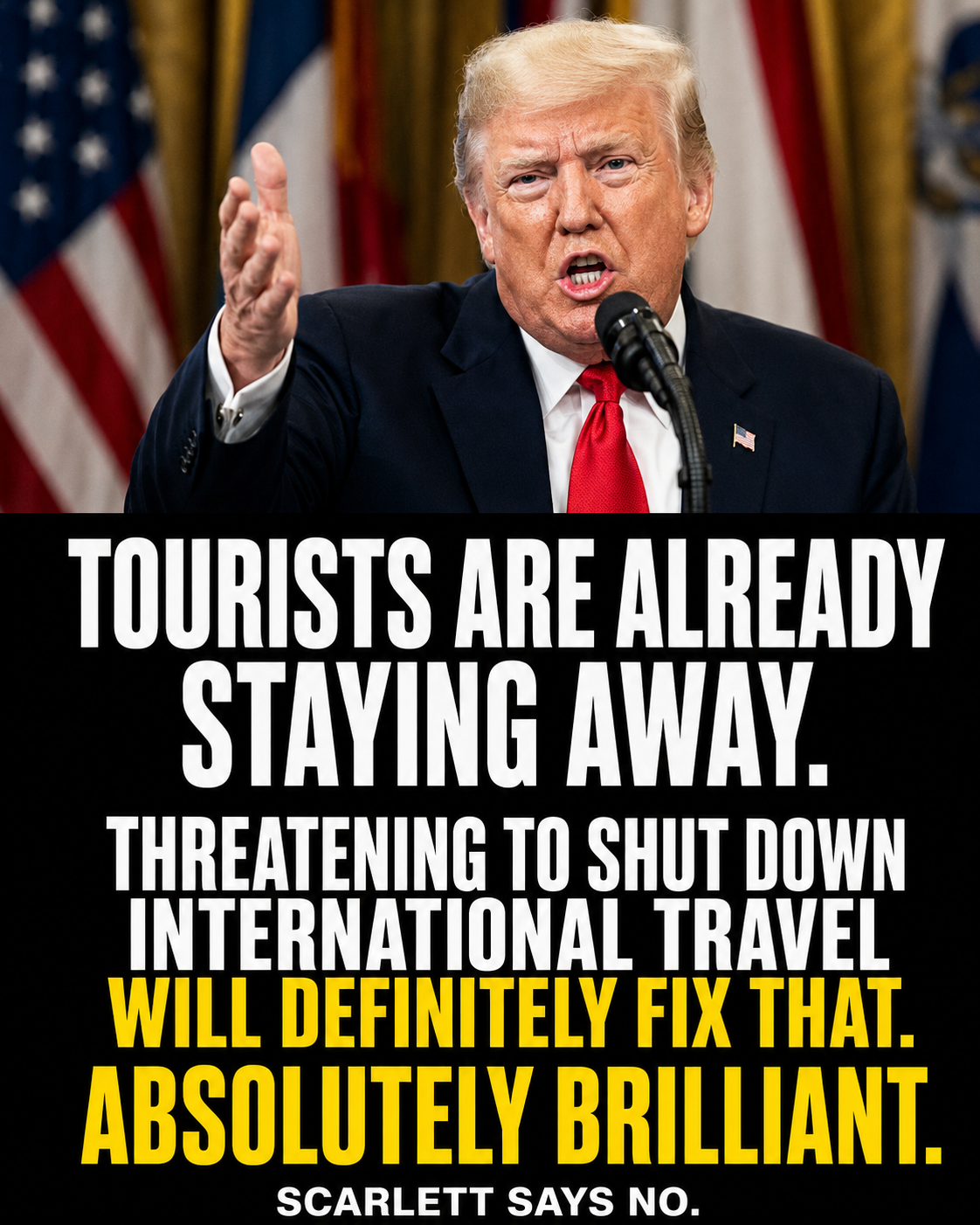
    While telling the World to Stay Home

    WELCOME TO AMERICA

    *Terms and conditions may change without notice.*

    The World Cup is supposed to be one of those rare events that brings the world together.

    Countries spend years competing for the opportunity to host it.

    Cities invest millions.

    Hotels prepare.

    Airlines prepare.

    Fans save money for years to make the trip.

    And then there is America.

    The United States spent years pursuing the World Cup.

    Tickets were sold.

    Hotels were booked.

    Flights were reserved.

    Travel plans were made.

    People spent real money based on the assumption that when America said, “Come visit,” America actually meant it.

    Now some international visitors are discovering that invitation may have come with fine print.

    That’s not just frustrating.

    It’s embarrassing.

    Imagine inviting hundreds of people to your house for dinner, collecting money for the event, confirming the guest list, and then deciding at the last minute that some of them might not be allowed through the front door.

    Most people would call that bad hosting.

    When governments do it, we call it policy.

    The comments on my original post were fascinating.

    Some people immediately shrugged and said it wasn’t their problem.

    Others joked that America First has become America Alone.

    A few pointed out that international sporting organizations may be paying close attention.

    What struck me wasn’t the politics.

    It was the message.

    Because whether you’re talking about tourism, international business, sporting events, or diplomacy, trust matters.

    When a country invites the world, people expect the rules to be clear.

    They expect consistency.

    They expect fairness.

    Most importantly, they expect the rules not to change after they’ve already paid the bill.

    The World Cup isn’t just a soccer tournament.

    It’s a global showcase.

    Millions of people watch.

    Hundreds of thousands travel.

    It’s an opportunity to show the world who we are.

    The question is whether we’re sending the message we think we’re sending.

    Because “Welcome to America” sounds very different from:

    “Welcome to America, subject to change without notice.”

    Scarlett says no.