Category: Scarlett Rants

  • Citizenship Isn’t Supposed To Come With An Expiration Date

    Citizenship Isn’t Supposed To Come With An Expiration Date

    The Department of Justice issued a memo in 2025 directing attorneys to “prioritize and maximally pursue” denaturalization cases — the legal process used to revoke citizenship from naturalized Americans. That part is not speculation. That’s public record.  

    Historically, denaturalization has been rare and generally reserved for cases involving fraud during the citizenship process, war crimes, terrorism, or other serious misconduct. Courts have treated citizenship as one of the most protected rights a person can possess.  

    The concern is not that millions of people are losing citizenship tomorrow.

    The concern is that the federal government is actively expanding a tool that was once used only sparingly.

    Once government gains a new power, history suggests it rarely volunteers to give that power back.

    Today’s target may be someone accused of fraud.

    Tomorrow’s target may be someone a different administration decides is “important” enough to pursue.

    That’s why civil liberties organizations, immigration attorneys, and constitutional scholars are paying attention. Not because denaturalization is new, but because the scope and priority surrounding it have changed.  

    Citizenship should mean something.

    If you followed every rule, completed every requirement, passed every test, swore every oath, and became an American citizen, that status should not feel conditional on who happens to occupy the White House.

    A nation built by immigrants should be very careful whenever government starts looking for new ways to decide who belongs.

    Scarlett says no.
  • The White House Has a Hall of Shame Now.

    The White House Has a Hall of Shame Now.

    You know what I expect to find on the official White House website?

    Information about the economy.

    Federal programs.

    Public policy.

    Resources for Americans.

    You know what I did not expect to find?

    An actual page called “Media Offenders” featuring an “Offender Hall of Shame,” a leaderboard, and categories including “Left-Wing Lunacy.”  

    I wish I were kidding.

    The website of the United States government now includes a searchable database dedicated to tracking reporters, journalists, and news organizations the administration doesn’t like. It even ranks outlets on a leaderboard described as a “race to the bottom.”  

    Because apparently we’re one step away from handing out detention slips.

    And if that wasn’t ridiculous enough, the White House has also encouraged the public to submit examples of alleged media bias so the database can continue to grow.  

    Think about that for a second.

    The government isn’t asking for ideas to lower housing costs.

    It isn’t crowdsourcing solutions for healthcare.

    It isn’t collecting suggestions for making life more affordable.

    It’s asking people to help maintain a government-sponsored complaint board for journalists.

    You don’t have to agree with every reporter.

    You don’t have to trust every news outlet.

    You don’t have to like what the press writes.

    That’s freedom.

    But when the people in power start using taxpayer-funded government resources to create official enemies lists for the people questioning them, every American should pay attention.

    Because a free press is supposed to hold power accountable.

    Power is not supposed to keep score.

    And if the White House has enough spare time to build a Hall of Shame for reporters, maybe it’s time to ask why they aren’t spending that time fixing the problems Americans actually elected them to solve.

  • Who Is Scarlett and Why Does She Say No?

    Who Is Scarlett and Why Does She Say No?

    A few days ago, I briefly introduced myself on Threads.

    I wrote:

    “Yes, I’m a liberal white woman.

    Today I’m headed to a Pride fair here in Massachusetts because I support people having the freedom to be themselves without politicians, preachers, or strangers obsessing over their existence.

    What a wild concept.”

    The response was overwhelming.

    People introduced themselves from all over the country.

    Some talked about healthcare.

    Some talked about women’s rights.

    Some talked about housing.

    Some talked about equality.

    Many talked about simply wanting people to be left alone to live their lives.

    And honestly?

    That tells you almost everything you need to know about Scarlett.

    Scarlett isn’t a political party.

    Scarlett isn’t a candidate.

    Scarlett isn’t a media company.

    Scarlett is a reaction.

    A reaction to the growing belief that cruelty is strength.

    A reaction to the idea that basic human dignity is somehow controversial.

    A reaction to watching people spend more energy attacking their neighbors than fixing the problems in their own communities.

    I believe people should be free to be themselves.

    I believe healthcare should be accessible.

    I believe women should have the right to make decisions about their own bodies.

    I believe public education matters.

    I believe facts matter.

    I believe corruption should be called out regardless of which political party is involved.

    And I believe that if your entire political identity revolves around making life harder for other people, you’ve probably lost the plot.

    That doesn’t mean everyone has to agree with me.

    In fact, disagreement is healthy.

    Some of the best conversations I’ve had here have been with people who see the world differently.

    But there is a difference between disagreement and dehumanization.

    There is a difference between debate and cruelty.

    There is a difference between solving problems and simply finding new people to blame.

    You’ll find a little bit of everything here.

    Politics.

    Public policy.

    Consumer warnings.

    Government accountability.

    Education.

    Occasional sarcasm.

    Frequent frustration.

    And the occasional moment where I stare at the news and ask:

    “What in the flip?”

    This website exists because too many people have stopped paying attention.

    Or worse, they’ve been convinced that paying attention doesn’t matter.

    It does.

    The people making decisions count on the rest of us being too distracted, too exhausted, or too overwhelmed to notice.

    Scarlett notices.

    And when something doesn’t make sense, when the facts don’t add up, or when someone in power expects us to quietly accept nonsense as normal — well, Scarlett says no.

  • World Cup Travel Restrictions

    World Cup Travel Restrictions

    Can America Host the World

    While telling the World to Stay Home

    WELCOME TO AMERICA

    *Terms and conditions may change without notice.*

    The World Cup is supposed to be one of those rare events that brings the world together.

    Countries spend years competing for the opportunity to host it.

    Cities invest millions.

    Hotels prepare.

    Airlines prepare.

    Fans save money for years to make the trip.

    And then there is America.

    The United States spent years pursuing the World Cup.

    Tickets were sold.

    Hotels were booked.

    Flights were reserved.

    Travel plans were made.

    People spent real money based on the assumption that when America said, “Come visit,” America actually meant it.

    Now some international visitors are discovering that invitation may have come with fine print.

    That’s not just frustrating.

    It’s embarrassing.

    Imagine inviting hundreds of people to your house for dinner, collecting money for the event, confirming the guest list, and then deciding at the last minute that some of them might not be allowed through the front door.

    Most people would call that bad hosting.

    When governments do it, we call it policy.

    The comments on my original post were fascinating.

    Some people immediately shrugged and said it wasn’t their problem.

    Others joked that America First has become America Alone.

    A few pointed out that international sporting organizations may be paying close attention.

    What struck me wasn’t the politics.

    It was the message.

    Because whether you’re talking about tourism, international business, sporting events, or diplomacy, trust matters.

    When a country invites the world, people expect the rules to be clear.

    They expect consistency.

    They expect fairness.

    Most importantly, they expect the rules not to change after they’ve already paid the bill.

    The World Cup isn’t just a soccer tournament.

    It’s a global showcase.

    Millions of people watch.

    Hundreds of thousands travel.

    It’s an opportunity to show the world who we are.

    The question is whether we’re sending the message we think we’re sending.

    Because “Welcome to America” sounds very different from:

    “Welcome to America, subject to change without notice.”

    Scarlett says no.

  • Why Should I Pay For Public Schools If I Don’t Have Kids?

    Why Should I Pay For Public Schools If I Don’t Have Kids?

    Every time the subject of school funding comes up, somebody asks the same question

    “I don’t have kids. Why should I pay for schools?”

    At first glance, it sounds reasonable.

    Why should you pay for a service you’re not personally using?

    But that’s actually the wrong question.

    The better question is:

    What kind of society do you want to live in?

    Because today’s students become tomorrow’s adults.

    The kid sitting in a public school classroom today may eventually become your nurse.

    Your electrician.

    Your accountant.

    Your mechanic.

    Your pharmacist.

    Your physical therapist.

    Your neighbor.

    The person reading your MRI.

    The person filling your prescription.

    The person repairing the brakes on your car.

    The person responding when you call 911.

    Whether you have children or not, you depend on educated people every single day.

    That’s the point.

    Public education isn’t a private benefit.

    It’s public infrastructure.

    Nobody asks:

    “I don’t drive on every road. Why should I help pay for roads?”

    Nobody says:

    “I’ve never called the fire department. Why should I help pay for firefighters?”

    Most people understand that some services exist because they make society function.

    Public education belongs in that category.

    In fact, you could argue it’s one of the most important investments we make.

    Because every other system depends on it.

    Healthcare depends on educated workers.

    Businesses depend on educated workers.

    Government depends on educated workers.

    Technology depends on educated workers.

    The economy depends on educated workers.

    And here’s the part many people miss:

    Maybe somebody without children helped pay for your education.

    Maybe they paid school taxes for decades.

    Maybe they never stepped foot inside a classroom as a parent.

    But they understood something important:

    An educated population benefits everyone.

    The reality is that most of us use public services that don’t directly benefit us every day.

    People without children help fund schools.

    Young people help fund Medicare.

    People who don’t drive help fund roads.

    People who never call 911 help fund emergency services.

    That’s how communities work.

    We all contribute to systems that make life better, safer, and more functional for everyone.

    The alternative is a society where every person only pays for what immediately benefits them.

    And that’s not really a society at all.

    It’s a collection of individuals hoping someone else solves the problem.

    Scarlett says no.

  • Before We Eliminate Taxes

    Before We Eliminate Taxes

    Let’s Talk About What We’re Paying For

    I made what I thought was a pretty simple post:

    Before someone complains about taxes, they must list every public service they are willing to personally give up.

    Roads?

    Fire departments?

    911?

    Public schools?

    Libraries?

    Clean water?

    Food inspections?

    Go ahead. Be specific.

    The responses were fascinating.

    One person said they’d happily give up libraries because of a bad experience at their local branch.

    Another pointed out that they have a private well and septic system.

    Someone else immediately shifted the conversation to immigrants and foreign aid.

    And that’s when I realized something.

    We don’t actually have a tax debate in America.

    We have a public services debate disguised as a tax debate.

    Most people say they want lower taxes.

    Far fewer can tell you exactly which services they want eliminated to make that happen.

    Want lower property taxes?

    Okay.

    How are schools funded?

    Want lower state taxes?

    Okay.

    Which roads won’t get repaired?

    Want lower federal taxes?

    Okay.

    What happens to veterans’ benefits, air traffic control, food safety inspections, disaster relief, national parks, border security, Medicare, Social Security, and the military?

    These aren’t trick questions.

    They’re the actual questions.

    The person with the private well and septic system made a fair point. There are advantages to being responsible for your own infrastructure.

    I grew up with well water and septic.

    I also remember the well going dry.

    I remember the septic system needing repairs.

    Neither was cheap.

    That’s the thing about infrastructure.

    You pay for it one way or another.

    Either collectively through taxes or individually through repairs, fees, insurance, maintenance, and replacement costs.

    The money doesn’t magically disappear because the tax bill does.

    As for libraries becoming irrelevant?

    That’s another conversation worth having.

    But libraries today are often much more than books.

    They provide internet access, job search assistance, educational programming, community meeting space, technology access, and resources for people who otherwise couldn’t afford them.

    The bigger issue is this:

    Too many tax debates begin with what people don’t want to pay.

    Very few begin with what people are willing to lose.

    And until we’re willing to answer that second question honestly, we’re not really debating taxes.

    We’re just complaining about the bill.

    Scarlett says no.

  • The World Kept Traveling.

    The World Kept Traveling.

    Fewer people chose us


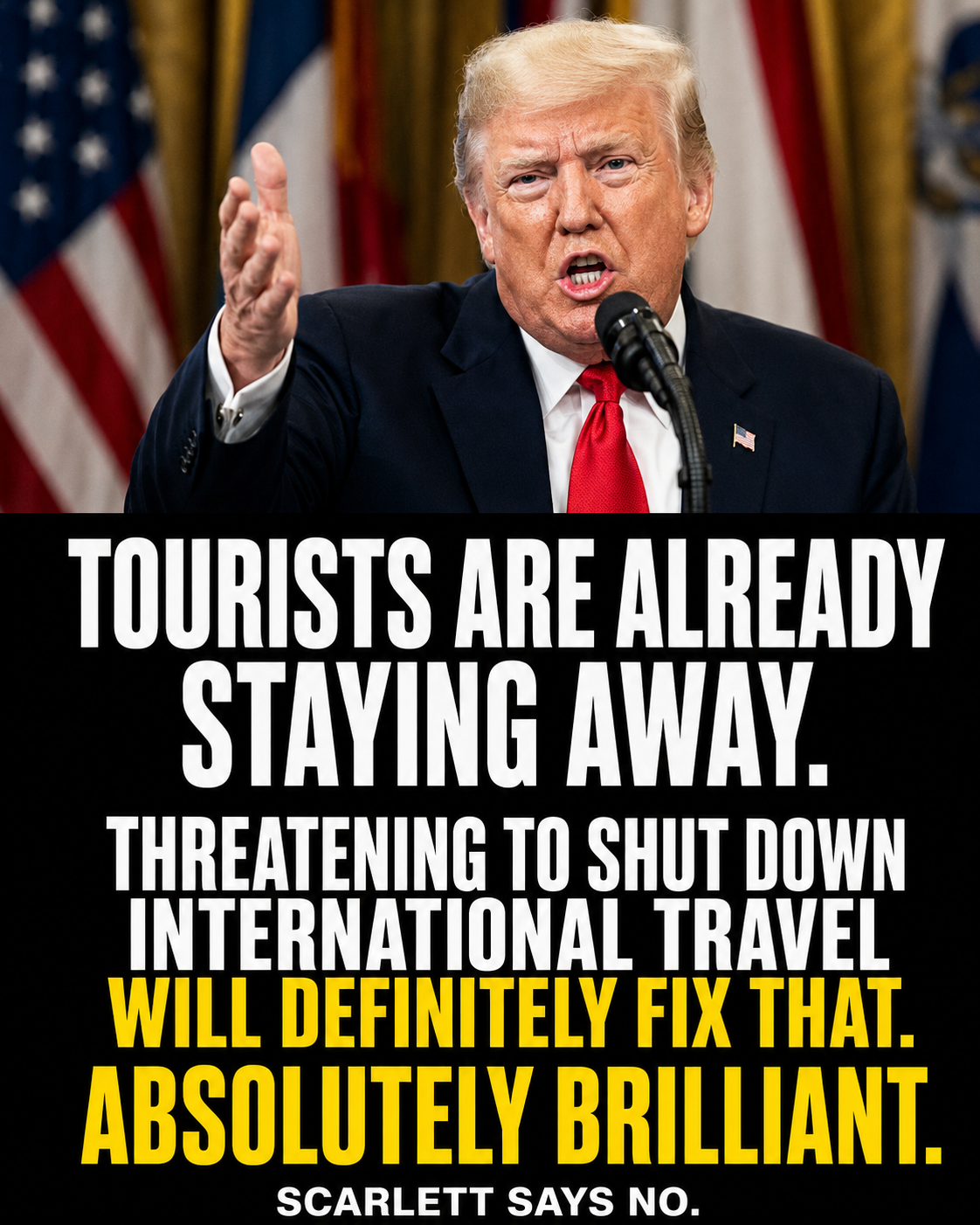
    The rest of the world kept traveling in 2025.

    Eighty million more people took international trips.

    But visits to the United States fell 5.5%.

    International visitor spending in the U.S. dropped 4.6% to $176 billion.

    Meanwhile, the global tourism industry had its best year ever, contributing a record $11.6 trillion to the global economy.

    The world moved forward.

    America went backward.

    What in the flipping hell is that?

    This Is Not Just About Vacations

    Tourism means jobs.

    It means hotel rooms, restaurant meals, museum tickets, local shops, rental cars, and money flowing into communities across the country.

    International travelers spend more, stay longer, and support businesses across the United States.

    When fewer people visit, American workers and small businesses pay the price.

    Hostility Is Not a Tourism Strategy

    Travelers have choices.

    They can spend their money somewhere that feels safer, calmer, and more welcoming.

    You cannot spend years treating outsiders like enemies and then act shocked when fewer people show up with suitcases and credit cards.

    That is not “America First.”

    That is self-sabotage wrapped in a flag.

    The world kept traveling.

    Fewer people chose us.

    Maybe it is time to ask why.

    Scarlett says no.