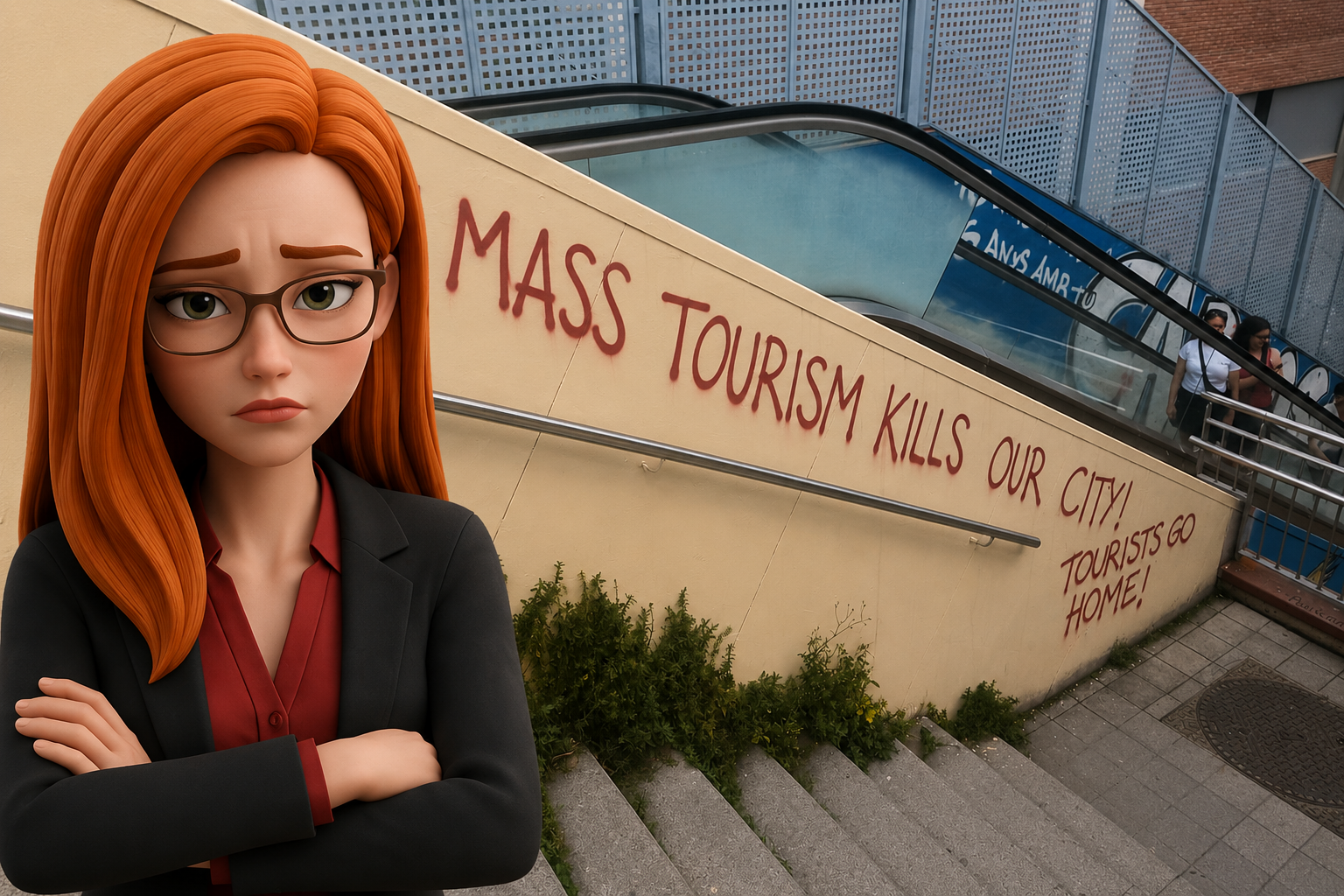
The first time I visited was about 15 years ago. Before Airbnb exploded. Before every spare bedroom, apartment, and broom closet became a vacation rental opportunity.
I returned in 2025.
The city was still beautiful.
The architecture was still stunning.
The food was still incredible.
But something felt different.
For the first time, I found myself paying attention to the people who actually lived there.
Not the tourists.
Not the influencers.
Not the travel bloggers.
The residents.
The people trying to afford rent.
The people trying to raise families.
The people watching their neighborhoods slowly transform into destinations rather than communities.
And it got me thinking.
We celebrate growth as if it’s automatically a good thing.
But growth for whom?
At what point does a neighborhood stop being a neighborhood and become a product?
At what point does “economic opportunity” become “you can no longer afford to live where your family has lived for generations”?
Those aren’t just Barcelona questions.
They’re everywhere.
We’ve seen it in cities.
We’ve seen it in small towns.
We’ve seen investors buy homes faster than families can.
We’ve seen communities transformed into assets.
We’ve seen people priced out of places they helped build.
Barcelona just made it impossible to ignore.
The city is still beautiful.
But beauty isn’t enough.
A place isn’t just its buildings.
It’s the people.
The culture.
The history.
The local businesses.
The families.
The community.
And if those things disappear, what exactly are we preserving?
Travel is supposed to broaden your perspective.
Barcelona did exactly that.
I arrived expecting to admire a city.
I left wondering whether we’ve become so obsessed with maximizing profit that we’ve forgotten the purpose of communities in the first place.
Scarlett says no.
Not to tourism.
Not to visitors.
But to the idea that every place on earth should be treated like a commodity.
There are places in the world that remind us how small we really are.
Pilanesberg National Park in South Africa is one of them.
Most of us spend our lives in environments designed for human convenience. Roads. Buildings. Grocery stores. Air conditioning. Traffic lights. Cell phones. Social media arguments with strangers we’ve never met.
We’ve become so accustomed to controlling our surroundings that we forget something important:
Nature never agreed to the arrangement.
The moment Scarlett entered Pilanesberg, the balance shifted.
Out here, humans are not the main characters.
The elephants don’t care about your itinerary.
The lions don’t care how much your camera cost.
The giraffes aren’t impressed by your social media following.
And the rhinoceroses certainly aren’t interested in your political opinions.
For a few hours, humans become what we actually are:
Just another species moving through the landscape.
And honestly?
It’s refreshing.
Modern life encourages us to believe everything revolves around us. Our deadlines. Our careers. Our elections. Our endless notifications. Our belief that we’re the smartest creatures to ever walk the Earth.
That last one might deserve a second look.
Scarlett’s guide, “Answer,” seemed perfectly named for the job. He had answers for nearly everything — tracks, animal behavior, where to look, when to wait, what a movement in the distance might mean.
But what made him interesting wasn’t just what he knew.
It was that he still asked questions.
Answer also talked about behavior.
Animal behavior.
Human behavior.
And the hard rule of the bush: you do not interrupt nature.
You watch.
You wait.
You respect the fact that you are not in charge.
That may sound simple, but for humans, apparently, it is advanced coursework.
It is asking us to shut up long enough to learn something.
He still watched carefully.
He still treated the landscape as something to learn from rather than something he had already figured out.
That’s a quality more humans could use.
Answer also explained the difference between white rhinos and black rhinos in the kind of plain, memorable way good guides do.
Both are rhinos.
Both are enormous.
Both could absolutely win an argument with a rental car.
But they are not the same.
White rhinos are grazers. They eat grass, keep their heads low, and are generally considered more passive.
Black rhinos are browsers. They eat leaves, shrubs, branches, and bushy plants. Some black rhinos also eat euphorbia, a plant with a toxic milky sap that most animals wisely avoid because, apparently, they have read the room.
Black rhinos, however, can tolerate it. And use it for strength and power.
Answer said that sap may be part of why black rhinos have their famously cranky reputation.
Scarlett cannot personally verify the rhino mood chemistry, and she is not about to walk up to one with a clipboard and ask follow-up questions.
But the larger point still stands.
Same family.
Different diets.
Different temperaments.
Different ways of surviving.
Nature, once again, refusing to fit neatly into human categories.
At one point, someone in the jeep couldn’t resist making the obvious comparison.
White rhinos.
Black rhinos.
Humans being humans, the conversation briefly drifted toward people.
Answer tilted his head, smiled, and seemed to acknowledge the comparison without fully taking the bait.
Because the interesting part wasn’t their color.
The interesting part was that they were different.
Different diets.
Different temperaments.
Different ways of moving through the world.
And yet somehow they managed to share the same park without spending all day obsessing over those differences.
The white rhinos weren’t demanding the black rhinos change.
The black rhinos weren’t campaigning against the white rhinos.
Neither group appeared particularly interested in convincing the other group that they were doing rhinoceros life incorrectly.
They simply existed.
Meanwhile, humans — allegedly the most intelligent species on Earth — have spent an astonishing amount of time finding reasons to divide ourselves into teams and then arguing about which team matters most.
Standing in Pilanesberg, surrounded by animals that seemed perfectly capable of adapting to one another’s existence, Scarlett found herself wondering whether intelligence and wisdom are two very different things.
The more Scarlett watched the animals, the more that thought kept creeping in.
For creatures we proudly describe as “wild,” they seemed surprisingly good at coexistence.
The zebras knew where the zebras belonged.
The giraffes knew where the giraffes belonged.
The elephants understood their role.
The lions understood theirs.
Nobody was demanding exclusive ownership of the watering hole.
Nobody was launching a disinformation campaign against antelope.
Nobody was trying to convince everyone else that the real problem facing the Mankwe River was a neighboring species simply existing.
Humans, meanwhile, have the internet and still can’t manage most of that.
Perhaps intelligence and wisdom aren’t exactly the same thing.
Travel has a way of teaching lessons you didn’t know you needed.
Sometimes those lessons come from museums.
Sometimes they come from conversations.
And sometimes they come from watching animals who have been adapting to their environment for thousands of years while humans spend their afternoons arguing about things that won’t matter next week.
A herd of elephants crosses a road.
A giraffe quietly reaches into a tree.
A rhino continues eating exactly what a rhino has evolved to eat.
No committee meeting required.
No strategic plan.
No opinion poll.
No billionaire funding a misinformation campaign.
Just life.
Pilanesberg is often promoted as a safari destination, and it absolutely is one.
But the wildlife isn’t what stayed with Scarlett.
What stayed with her was the perspective.
The reminder that the world is bigger than us.
Older than us.
And far less interested in our drama than we imagine.
The animals seemed perfectly content getting on with the business of survival.
Humans, on the other hand, appear determined to complicate absolutely everything.
After spending time in Pilanesberg, Scarlett wasn’t entirely convinced we’re the more adaptable species.
We’ve built remarkable things.
We’ve walked on the moon.
We’ve mapped the human genome.
We’ve invented artificial intelligence.
And yet a group of rhinos with different diets and different personalities somehow manage to share a national park without creating a constitutional crisis.
Maybe there’s a lesson in that.
Maybe the smartest thing humans could do once in a while is stop talking, start observing, and remember that the world doesn’t revolve around us.
Pilanesberg has been teaching that lesson for a very long time.
We just have to be willing to listen.
Cookie Consent
We use cookies to improve your experience on our site. By using our site, you consent to cookies.
Contains information related to marketing campaigns of the user. These are shared with Google AdWords / Google Ads when the Google Ads and Google Analytics accounts are linked together.
90 days
__utma
ID used to identify users and sessions
2 years after last activity
__utmt
Used to monitor number of Google Analytics server requests
10 minutes
__utmb
Used to distinguish new sessions and visits. This cookie is set when the GA.js javascript library is loaded and there is no existing __utmb cookie. The cookie is updated every time data is sent to the Google Analytics server.
30 minutes after last activity
__utmc
Used only with old Urchin versions of Google Analytics and not with GA.js. Was used to distinguish between new sessions and visits at the end of a session.
End of session (browser)
__utmz
Contains information about the traffic source or campaign that directed user to the website. The cookie is set when the GA.js javascript is loaded and updated when data is sent to the Google Anaytics server
6 months after last activity
__utmv
Contains custom information set by the web developer via the _setCustomVar method in Google Analytics. This cookie is updated every time new data is sent to the Google Analytics server.
2 years after last activity
__utmx
Used to determine whether a user is included in an A / B or Multivariate test.
18 months
_ga
ID used to identify users
2 years
_gali
Used by Google Analytics to determine which links on a page are being clicked
30 seconds
_ga_
ID used to identify users
2 years
_gid
ID used to identify users for 24 hours after last activity
24 hours
_gat
Used to monitor number of Google Analytics server requests when using Google Tag Manager