Category: Trump, MAGA & Accountability

  • Trump’s Name Is Being Removed From the Kennedy

    Trump’s Name Is Being Removed From the Kennedy

    Turns out you cannot just slap your name on a national cultural institution because your ego needs more square footage.

    Workers are removing Donald Trump’s name from the Kennedy Center after a federal judge ruled that the Trump-controlled board did not have the legal authority to rename the building.

    That’s right….A national memorial honoring President John F. Kennedy was renamed after Donald Trump.

    Not by Congress.

    Not by the American people.

    Not because of some overwhelming public demand.

    Just because people with power decided that apparently every building, airport, golf course, and flat surface in America should eventually have Trump’s name on it.

    And now the letters are coming down.

    This Is About More Than a Sign

    The Kennedy Center does not belong to Donald Trump.

    It does not belong to his board.

    It does not belong to whichever political party happens to be in power.

    It belongs to the American people.

    That is why the court stepped in.

    Because public institutions are not personal trophies.

    Imagine if every president simply renamed national landmarks after themselves.

    The Lincoln Memorial becomes the Obama Memorial.

    The Washington Monument becomes the Bush Monument.

    The Statue of Liberty becomes whatever billionaire happened to be writing checks that week.

    Most Americans would immediately recognize how ridiculous that sounds.

    Yet somehow we are supposed to pretend this situation was perfectly normal.

    The Ego Never Stops

    This is the part that always amazes me.

    There are more than 600 Trump-branded properties around the world.

    Hotels.

    Golf courses.

    Residential towers.

    Resorts.

    Licensing deals.

    Merchandise.

    Books.

    Coins.

    NFTs.

    Shoes.

    Apparently that was still not enough.

    At some point the question stops being “Why are people taking the name down?”

    And becomes:

    “Why was it there in the first place?”

    The Workers Deserve an Award

    Somewhere in Washington, workers showed up with scaffolding, tools, and a court order.

    Honestly, they may be the heroes of the week.

    Because there is something beautifully symbolic about watching actual working people undo something powerful people never should have done.

    One letter at a time.

    One bolt at a time.

    One giant ego adjustment at a time.

    The Lesson

    Rules matter.

    Laws matter.

    Public institutions matter.

    And no matter how powerful someone becomes, they do not get to turn national landmarks into vanity projects.

    The letters are coming down.

    The court has spoken.

    The building survives.

    The republic survives.

    And somewhere, a tarp is doing the Lord’s work.

    What in the flip?

    Scarlett says no.
  • The Apache Crash Was Still Under Investigation.

    The Apache Crash Was Still Under Investigation.

    The Strikes Had Already Begun.

    Two American soldiers survived a terrifying helicopter crash near the Strait of Hormuz. Thank goodness. But Americans deserve to know why the military response moved faster than the public explanation.

    On June 8, a U.S. Army AH-64 Apache helicopter went down near the coast of Oman while patrolling regional waters.

    The two soldiers on board were rescued within approximately two hours. They were reported to be in stable condition.

    That is the good news.

    The deeply troubling part is what happened next.

    U.S. Central Command announced that the cause of the incident was still under investigation.

    Then, on June 9, CENTCOM announced that the United States had completed strikes against Iranian air-defense systems, ground-control stations, and surveillance-radar sites near the Strait of Hormuz. CENTCOM described the strikes as a response to Iran’s downing of the helicopter and to recent attacks on U.S. forces and commercial ships.

    Apparently, the investigation was still open, but the missiles did not need to wait for the paperwork.

    What Do We Actually Know?

    A U.S. official told Reuters that the Apache had been brought down by an Iranian one-way attack drone.

    Iran disputed that account. Iranian state media cited a military source claiming that the country had not conducted offensive air operations in the Strait of Hormuz during the previous 24 hours.

    President Donald Trump then added his own dramatic description, telling reporters that an Iranian “bomb” had lodged inside the helicopter without exploding.

    Perhaps every detail of that account will ultimately be confirmed.

    Perhaps it will not.

    That is precisely why investigations exist.

    The American people should not have to piece together the justification for military escalation from an official press release, an unnamed source, a presidential monologue, and conflicting accounts from a hostile foreign government.

    Questions Are Not Betrayal

    There is a predictable response whenever anyone asks uncomfortable questions about military action.

    Why are you defending Iran?

    Why do you hate the troops?

    Why can’t you just trust the president?

    Please.

    Demanding accurate information before a conflict widens is not defending Iran. It is defending American service members who may be sent into an increasingly dangerous situation. It is defending civilians who do not get to opt out when bombs begin falling. It is defending the public’s right to understand what is being done in our name.

    The two soldiers aboard that Apache deserved a rescue mission. They deserved the full weight of the United States military working to bring them home safely.

    They also deserve leaders who do not treat their terrifying experience as a convenient blank check for escalation.

    Americans Have Seen This Movie Before

    This country has learned, repeatedly and painfully, what happens when certainty is announced before the evidence is fully explained.

    A military response can trigger retaliation.

    Retaliation can trigger another response.

    Oil prices rise. Gas prices rise. Markets react. Families feel the consequences. Service members are placed in greater danger. Civilians thousands of miles away pay with their lives.

    And suddenly the public is being told that asking how we got here is somehow unpatriotic.

    No.

    When a helicopter goes down and American soldiers are endangered, Americans deserve the truth.

    When military strikes follow, Americans deserve even more of it.

    Not eventually.

    Not after the story changes three times.

    Before the next round of escalation begins.

    What in the flip?

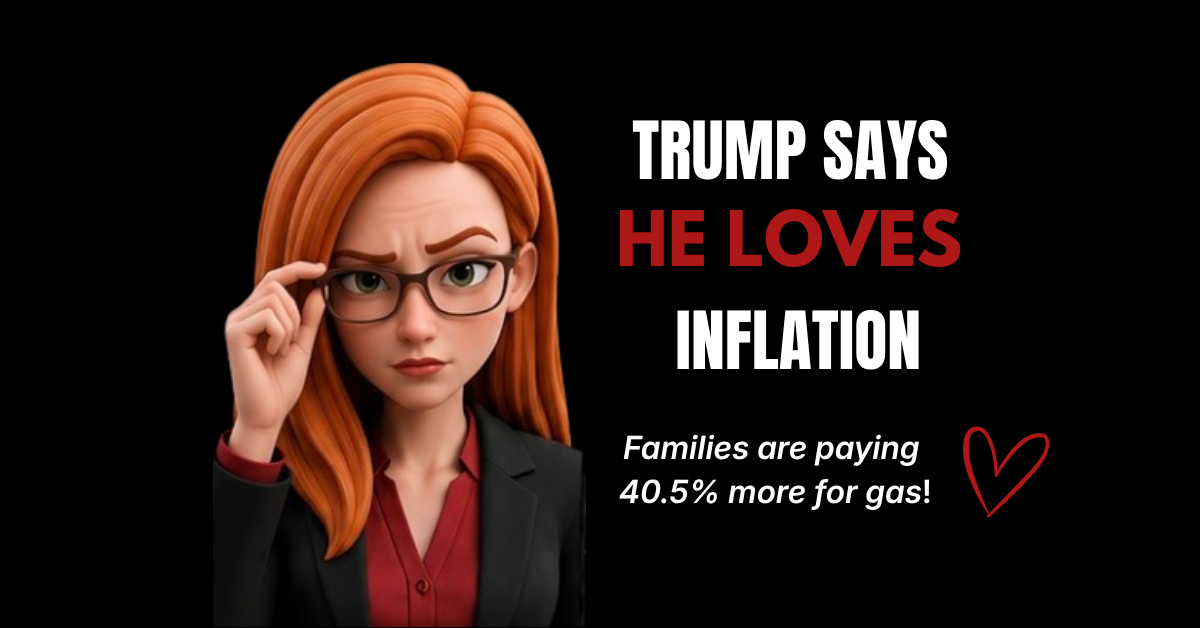
  • Trump “Loves” Inflation

    Trump “Loves” Inflation

    While Families Pay 40.5% More for Gas

    Apparently, rising prices are delightful when you are not the person standing at the gas pump watching the numbers spin.

    Inflation climbed to 4.2% in May, the highest annual rate in three years. Prices rose another 0.5% in a single month. Energy costs increased 23.5% over the past year. Gasoline prices jumped 40.5%.

    And President Donald Trump’s response?

    “I love the inflation.”

    Yes. He actually said that.

    Trump later tried to explain that he believed the numbers were better than expected given the war with Iran. But ordinary people do not pay their bills with presidential spin. They pay them with actual money. And every dollar spent filling the tank is a dollar that cannot be spent on groceries, rent, childcare, medications, or the electric bill.

    Inflation Is Not an Abstract Number

    Inflation is often discussed as though it is a political scoreboard.

    It is not.

    It is the parent wondering whether the family can afford the summer road trip they already promised the kids.

    It is the worker whose commute suddenly costs substantially more, even though the paycheck did not magically grow with the gas bill.

    It is the small business owner paying more for deliveries and trying to decide whether to raise prices or absorb another hit.

    It is the retiree watching a fixed income stretch a little less every month.

    The latest government report shows that the pain is not limited to gasoline. Energy prices rose sharply in May, while shelter costs, airline fares, medical care, personal care, and recreation also increased. Food prices rose 3.1% over the past year.

    The Gas Pump Does Not Care About Political Excuses

    The White House argues that the rising costs are temporary disruptions related to the Iran conflict and that prices will fall when the situation is resolved. Perhaps they will. Families certainly hope so.

    But this administration does not get to treat a 40.5% increase in gasoline prices like an interesting little inconvenience.

    People remember being promised lower prices.

    They remember being told that affordability would improve.

    They remember hearing that everything would be fixed quickly and easily.

    Now they are being told to celebrate inflation because it could have been worse.

    That is not a solution. That is a shrug from people who do not feel the consequences the way ordinary families do.

    Read the Room

    A president saying that he “loves” inflation while millions of people are paying more for basic necessities is not merely a clumsy choice of words.

    It reveals a much larger problem.

    Too many powerful people experience economic pain as a press-conference question. Everyone else experiences it when the debit card is declined, when the credit-card balance grows, or when one more ordinary expense becomes something that has to wait until payday.

    Families are not asking for a victory lap.

    They are asking how they are supposed to absorb another round of rising prices.

    What in the flip?

  • The Billionaire and the Predator.

    The Billionaire and the Predator.

    Bill Gates told Congress Jeffrey Epstein tried to blackmail him over an affair.

    And somehow we are still supposed to pretend the real scandal is “poor judgment.”

    No.

    This was not a confusing social mix-up at a charity luncheon.

    Gates knew Epstein had been convicted of sex crimes. He kept meeting with him anyway because Epstein supposedly had access to rich donors.

    There it is.

    A convicted sex offender became acceptable because he was useful.

    Gates denies criminal wrongdoing, says he never went to Epstein’s island or homes, and called the whole thing a “grave error in judgment.”

    Fine.

    But his name reportedly appears more than 3,000 times in Epstein-related federal records.

    That is not “oops.”

    That is “open the damn transcript.”

    The survivors deserve answers. The public deserves answers. And billionaires do not get a special privacy curtain when the subject is a child sex trafficker and the people around him.

    Scarlett says no.


  • War Crimes Are Not Complicated

    War Crimes Are Not Complicated

    Every time a war dominates the news, the same arguments appear.

    “What about what the other side did?”

    “They started it.”

    “They deserve it.”

    “They had it coming.”

    That’s not how war crimes work.

    In fact, the entire reason international law exists is because human beings discovered what happens when armies, governments, and leaders convince themselves that anything is justified if they hate the enemy enough.

    The rules are actually pretty simple.

    Don’t deliberately target civilians.

    Don’t torture people.

    Don’t rape people.

    Don’t execute prisoners.

    Don’t kidnap children.

    Don’t starve entire populations.

    Don’t take hostages.

    Don’t use human shields.

    Don’t bomb hospitals, schools, or humanitarian workers.

    Don’t force people from their homes because of who they are.

    These aren’t controversial ideas.

    They aren’t partisan ideas.

    They aren’t liberal ideas or conservative ideas.

    They’re human ideas.

    The world spent centuries watching governments commit atrocities and finally agreed that there had to be limits, even during war.

    Especially during war.

    The problem is that people often support these rules only when their enemies are accused of breaking them.

    The moment someone on their “team” is accused, the conversation changes.

    Suddenly there are excuses.

    Suddenly there are exceptions.

    Suddenly civilian deaths become statistics.

    Suddenly starving children becomes strategy.

    Suddenly human suffering becomes collateral damage.

    No.

    The rules either apply to everyone or they apply to no one.

    If deliberately killing civilians is wrong when your enemy does it, it’s wrong when your side does it.

    If kidnapping children is wrong when your enemy does it, it’s wrong when your side does it.

    If starvation, torture, rape, and collective punishment are wrong, they’re wrong regardless of which flag is flying overhead.

    That is the entire point.

    War crimes are not complicated.

    What’s complicated is people’s willingness to overlook them when they’re committed by someone they support.

    Scarlett says no.

  • The White House Has a Hall of Shame Now.

    The White House Has a Hall of Shame Now.

    You know what I expect to find on the official White House website?

    Information about the economy.

    Federal programs.

    Public policy.

    Resources for Americans.

    You know what I did not expect to find?

    An actual page called “Media Offenders” featuring an “Offender Hall of Shame,” a leaderboard, and categories including “Left-Wing Lunacy.”  

    I wish I were kidding.

    The website of the United States government now includes a searchable database dedicated to tracking reporters, journalists, and news organizations the administration doesn’t like. It even ranks outlets on a leaderboard described as a “race to the bottom.”  

    Because apparently we’re one step away from handing out detention slips.

    And if that wasn’t ridiculous enough, the White House has also encouraged the public to submit examples of alleged media bias so the database can continue to grow.  

    Think about that for a second.

    The government isn’t asking for ideas to lower housing costs.

    It isn’t crowdsourcing solutions for healthcare.

    It isn’t collecting suggestions for making life more affordable.

    It’s asking people to help maintain a government-sponsored complaint board for journalists.

    You don’t have to agree with every reporter.

    You don’t have to trust every news outlet.

    You don’t have to like what the press writes.

    That’s freedom.

    But when the people in power start using taxpayer-funded government resources to create official enemies lists for the people questioning them, every American should pay attention.

    Because a free press is supposed to hold power accountable.

    Power is not supposed to keep score.

    And if the White House has enough spare time to build a Hall of Shame for reporters, maybe it’s time to ask why they aren’t spending that time fixing the problems Americans actually elected them to solve.

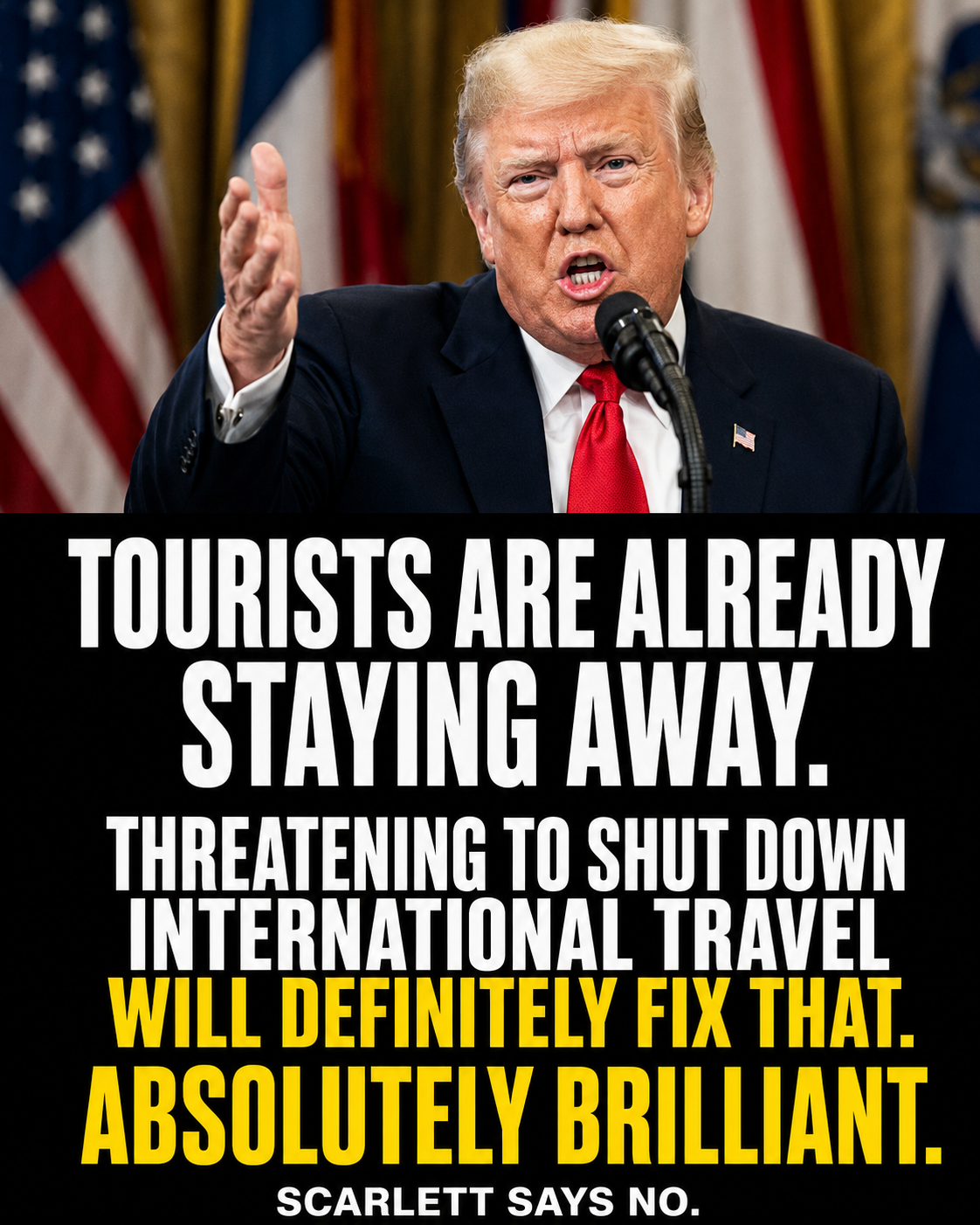
  • The World Kept Traveling.

    The World Kept Traveling.

    Fewer people chose us


    The rest of the world kept traveling in 2025.

    Eighty million more people took international trips.

    But visits to the United States fell 5.5%.

    International visitor spending in the U.S. dropped 4.6% to $176 billion.

    Meanwhile, the global tourism industry had its best year ever, contributing a record $11.6 trillion to the global economy.

    The world moved forward.

    America went backward.

    What in the flipping hell is that?

    This Is Not Just About Vacations

    Tourism means jobs.

    It means hotel rooms, restaurant meals, museum tickets, local shops, rental cars, and money flowing into communities across the country.

    International travelers spend more, stay longer, and support businesses across the United States.

    When fewer people visit, American workers and small businesses pay the price.

    Hostility Is Not a Tourism Strategy

    Travelers have choices.

    They can spend their money somewhere that feels safer, calmer, and more welcoming.

    You cannot spend years treating outsiders like enemies and then act shocked when fewer people show up with suitcases and credit cards.

    That is not “America First.”

    That is self-sabotage wrapped in a flag.

    The world kept traveling.

    Fewer people chose us.

    Maybe it is time to ask why.

    Scarlett says no.