Category: Scarlett Latest

  • Two Bad Voting Ideas. One Very Obvious Goal.

    Two Bad Voting Ideas. One Very Obvious Goal.

    There are two different ideas being floated here, and both are bad.

    They are not exactly the same.

    They are just bad in different ways.

    Bad Idea #1: “One Household, One Vote”

    This is the idea that a household should vote as one unit.

    Sounds cozy, right?

    A family meeting. A dinner-table discussion. A little civic togetherness.

    Except households are not governments.

    Households are made up of individual people with individual rights.

    A wife does not lose her political voice because she got married.

    An adult child living at home does not become a footnote.

    A grandmother in the guest room does not get absorbed into someone else’s ballot.

    And let’s not pretend we don’t know how this usually works.

    The “household vote” almost always points back to the old “head of household” model — meaning one person gets treated like the decision-maker, and everyone else gets told to be agreeable.

    That is not democracy.

    That is disenfranchisement with curtains.

    Bad Idea #2: The “Family Vote”

    This one is different.

    The “family vote” says parents should get extra voting power because they have children.

    So instead of one adult, one vote, parents would also vote on behalf of their kids.

    A couple with four children could potentially have six votes.

    A single adult gets one.

    A childless couple gets two.

    An infertile couple gets two.

    A retiree gets one.

    A young worker gets one.

    A person caring for aging parents gets no extra votes.

    See the problem?

    This does not give children a voice.

    It gives parents more power.

    Children are not filling out ballots.

    Children are not weighing tax policy, reproductive rights, education funding, foreign policy, healthcare, climate policy, or Supreme Court appointments.

    Their parents are.

    And parents already vote with their children’s futures in mind if they choose to.

    They do not need bonus ballots.

    The Real Problem

    Both ideas attack the same basic principle:

    One person. One vote.

    Not one household.

    Not one family unit.

    Not one adult plus bonus votes for dependents.

    Citizenship is not supposed to be weighted by marriage, fertility, household structure, religion, income, or whether someone has reproduced.

    Because the second we start saying some citizens deserve more political power than others, we are no longer protecting democracy.

    We are redesigning it for the people who already want control.

    And somehow, the people pushing these ideas always seem very confident they will be the ones holding the extra votes.

    Funny how that works.

    Scarlett says no thank you.

  • The Internet Didn’t Create Idiots.

    The Internet Didn’t Create Idiots.

    It Just Introduced Them to Each Other.

    Going around on threads ….

    A teacher once told me:

    “Being hated by idiots is the price you pay for not being one of them.”

    At the time, I thought it was funny.

    Then social media happened.

    The internet did something humanity had never experienced before.

    It gave every bad idea a search function.

    For most of human history, the village idiot was limited by geography. They could annoy a few neighbors, embarrass themselves at family gatherings, and occasionally yell something ridiculous at the town meeting.

    Then we invented comment sections.

    Now every conspiracy theory, every scam, every piece of misinformation, every grievance, every prejudice, and every wildly incorrect opinion can instantly find thousands of people willing to reinforce it.

    The internet didn’t create stupidity.

    It created networking opportunities for it.

    That’s why so many things feel crazier than they used to.

    The loudest voices are no longer filtered by expertise, evidence, experience, or reality. They’re filtered by engagement.

    The more outrageous something is, the more attention it receives.

    The more attention it receives, the more people see it.

    The more people see it, the more likely it is to find others who already wanted to believe it.

    Suddenly isolated bad ideas become communities.

    Communities become movements.

    Movements become political platforms.

    And then the rest of us are forced to spend our evenings explaining things that should have been settled in middle school science class.

    Being hated by idiots doesn’t automatically mean you’re right.

    If it did, every conspiracy theorist on the internet would be a genius.

    But there is something revealing about living in a time when facts, expertise, and evidence are treated like optional accessories.

    The real challenge isn’t avoiding idiots.

    It’s avoiding becoming one.

    Because the same algorithms that feed them are feeding us too.

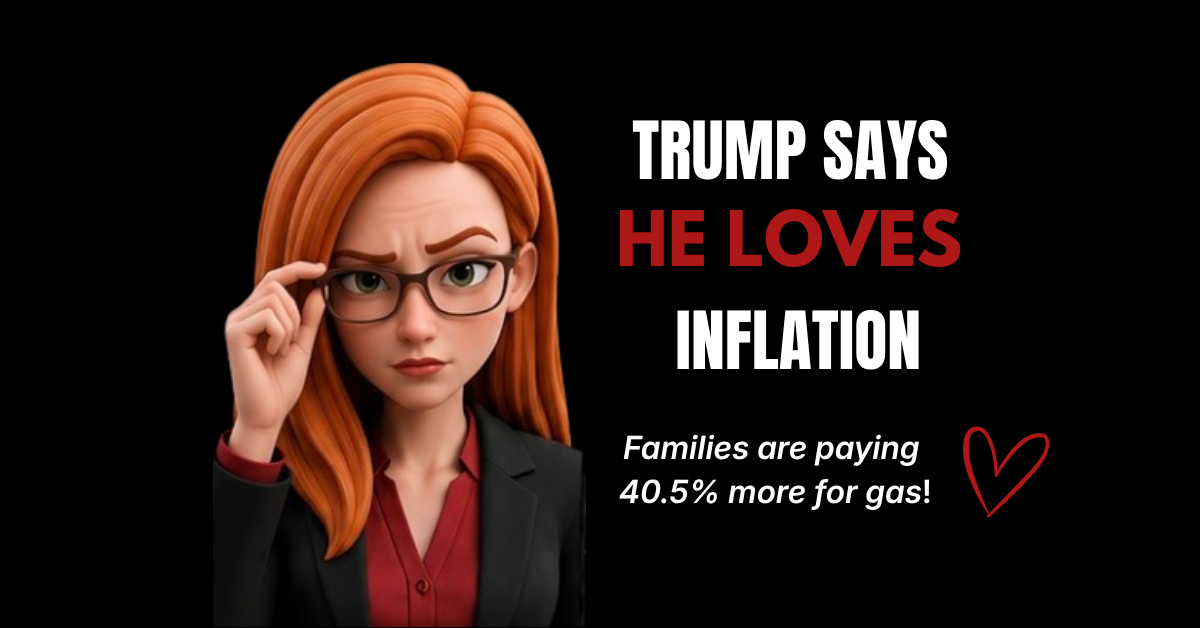
  • Trump “Loves” Inflation

    Trump “Loves” Inflation

    While Families Pay 40.5% More for Gas

    Apparently, rising prices are delightful when you are not the person standing at the gas pump watching the numbers spin.

    Inflation climbed to 4.2% in May, the highest annual rate in three years. Prices rose another 0.5% in a single month. Energy costs increased 23.5% over the past year. Gasoline prices jumped 40.5%.

    And President Donald Trump’s response?

    “I love the inflation.”

    Yes. He actually said that.

    Trump later tried to explain that he believed the numbers were better than expected given the war with Iran. But ordinary people do not pay their bills with presidential spin. They pay them with actual money. And every dollar spent filling the tank is a dollar that cannot be spent on groceries, rent, childcare, medications, or the electric bill.

    Inflation Is Not an Abstract Number

    Inflation is often discussed as though it is a political scoreboard.

    It is not.

    It is the parent wondering whether the family can afford the summer road trip they already promised the kids.

    It is the worker whose commute suddenly costs substantially more, even though the paycheck did not magically grow with the gas bill.

    It is the small business owner paying more for deliveries and trying to decide whether to raise prices or absorb another hit.

    It is the retiree watching a fixed income stretch a little less every month.

    The latest government report shows that the pain is not limited to gasoline. Energy prices rose sharply in May, while shelter costs, airline fares, medical care, personal care, and recreation also increased. Food prices rose 3.1% over the past year.

    The Gas Pump Does Not Care About Political Excuses

    The White House argues that the rising costs are temporary disruptions related to the Iran conflict and that prices will fall when the situation is resolved. Perhaps they will. Families certainly hope so.

    But this administration does not get to treat a 40.5% increase in gasoline prices like an interesting little inconvenience.

    People remember being promised lower prices.

    They remember being told that affordability would improve.

    They remember hearing that everything would be fixed quickly and easily.

    Now they are being told to celebrate inflation because it could have been worse.

    That is not a solution. That is a shrug from people who do not feel the consequences the way ordinary families do.

    Read the Room

    A president saying that he “loves” inflation while millions of people are paying more for basic necessities is not merely a clumsy choice of words.

    It reveals a much larger problem.

    Too many powerful people experience economic pain as a press-conference question. Everyone else experiences it when the debit card is declined, when the credit-card balance grows, or when one more ordinary expense becomes something that has to wait until payday.

    Families are not asking for a victory lap.

    They are asking how they are supposed to absorb another round of rising prices.

    What in the flip?

  • The Generation War Is a Distraction

    The Generation War Is a Distraction

    Spend five minutes online and you’ll find someone blaming Boomers for everything.

    Housing prices.

    Student debt.

    Healthcare costs.

    Stagnant wages.

    Retirement insecurity.

    Climate change.

    Pick a problem and somewhere, someone is explaining why an entire generation is responsible.

    It’s a convenient story.

    It’s also a distraction.

    Most Boomers weren’t CEOs. They weren’t senators. They weren’t hedge fund managers, corporate lobbyists, or billionaires writing tax policy.

    They were teachers, mechanics, nurses, factory workers, office staff, firefighters, truck drivers, small business owners, and parents trying to keep food on the table.

    Just like most Millennials.

    Just like most Gen Xers.

    Just like most Gen Z workers today.

    The average person wasn’t sitting around in the 1970s plotting how to make housing unaffordable fifty years later.

    They were working.

    Raising families.

    Paying bills.

    Trying not to drown.

    That doesn’t mean mistakes weren’t made. Policies were passed. Industries changed. Wealth became increasingly concentrated. Labor protections weakened. Housing became an investment vehicle instead of simply a place to live.

    But those decisions weren’t made by millions of ordinary people acting in unison.

    They were made by people with power.

    And that’s where the conversation should be.

    Because while we’re busy arguing about whether Boomers ruined everything or whether younger generations are entitled, the people who actually shape the rules rarely face the same scrutiny.

    The generation war is useful because it redirects anger.

    Instead of asking why housing is increasingly unaffordable, people blame Boomers.

    Instead of asking why wages haven’t kept pace with productivity, people blame Millennials.

    Instead of asking why young adults are struggling to get established, people blame Gen Z.

    Everyone gets a villain.

    Nobody examines the system.

    The truth is that most Americans, regardless of age, have far more in common with one another than they do with the people making the biggest decisions.

    Most people want decent schools.

    Affordable housing.

    Accessible healthcare.

    Safe communities.

    A fair shot.

    The generations aren’t the enemy.

    They’re simply different groups of people trying to survive under the same set of rules.

    And the longer we spend fighting each other, the less likely we are to ask who benefits from the fight in the first place.

    Maybe that’s why the generation war never seems to end.

    It’s a remarkably effective distraction.

    Scarlett says follow the money.

  • The Billionaire and the Predator.

    The Billionaire and the Predator.

    Bill Gates told Congress Jeffrey Epstein tried to blackmail him over an affair.

    And somehow we are still supposed to pretend the real scandal is “poor judgment.”

    No.

    This was not a confusing social mix-up at a charity luncheon.

    Gates knew Epstein had been convicted of sex crimes. He kept meeting with him anyway because Epstein supposedly had access to rich donors.

    There it is.

    A convicted sex offender became acceptable because he was useful.

    Gates denies criminal wrongdoing, says he never went to Epstein’s island or homes, and called the whole thing a “grave error in judgment.”

    Fine.

    But his name reportedly appears more than 3,000 times in Epstein-related federal records.

    That is not “oops.”

    That is “open the damn transcript.”

    The survivors deserve answers. The public deserves answers. And billionaires do not get a special privacy curtain when the subject is a child sex trafficker and the people around him.

    Scarlett says no.


  • War Crimes Are Not Complicated

    War Crimes Are Not Complicated

    Every time a war dominates the news, the same arguments appear.

    “What about what the other side did?”

    “They started it.”

    “They deserve it.”

    “They had it coming.”

    That’s not how war crimes work.

    In fact, the entire reason international law exists is because human beings discovered what happens when armies, governments, and leaders convince themselves that anything is justified if they hate the enemy enough.

    The rules are actually pretty simple.

    Don’t deliberately target civilians.

    Don’t torture people.

    Don’t rape people.

    Don’t execute prisoners.

    Don’t kidnap children.

    Don’t starve entire populations.

    Don’t take hostages.

    Don’t use human shields.

    Don’t bomb hospitals, schools, or humanitarian workers.

    Don’t force people from their homes because of who they are.

    These aren’t controversial ideas.

    They aren’t partisan ideas.

    They aren’t liberal ideas or conservative ideas.

    They’re human ideas.

    The world spent centuries watching governments commit atrocities and finally agreed that there had to be limits, even during war.

    Especially during war.

    The problem is that people often support these rules only when their enemies are accused of breaking them.

    The moment someone on their “team” is accused, the conversation changes.

    Suddenly there are excuses.

    Suddenly there are exceptions.

    Suddenly civilian deaths become statistics.

    Suddenly starving children becomes strategy.

    Suddenly human suffering becomes collateral damage.

    No.

    The rules either apply to everyone or they apply to no one.

    If deliberately killing civilians is wrong when your enemy does it, it’s wrong when your side does it.

    If kidnapping children is wrong when your enemy does it, it’s wrong when your side does it.

    If starvation, torture, rape, and collective punishment are wrong, they’re wrong regardless of which flag is flying overhead.

    That is the entire point.

    War crimes are not complicated.

    What’s complicated is people’s willingness to overlook them when they’re committed by someone they support.

    Scarlett says no.

  • Citizenship Isn’t Supposed To Come With An Expiration Date

    Citizenship Isn’t Supposed To Come With An Expiration Date

    The Department of Justice issued a memo in 2025 directing attorneys to “prioritize and maximally pursue” denaturalization cases — the legal process used to revoke citizenship from naturalized Americans. That part is not speculation. That’s public record.  

    Historically, denaturalization has been rare and generally reserved for cases involving fraud during the citizenship process, war crimes, terrorism, or other serious misconduct. Courts have treated citizenship as one of the most protected rights a person can possess.  

    The concern is not that millions of people are losing citizenship tomorrow.

    The concern is that the federal government is actively expanding a tool that was once used only sparingly.

    Once government gains a new power, history suggests it rarely volunteers to give that power back.

    Today’s target may be someone accused of fraud.

    Tomorrow’s target may be someone a different administration decides is “important” enough to pursue.

    That’s why civil liberties organizations, immigration attorneys, and constitutional scholars are paying attention. Not because denaturalization is new, but because the scope and priority surrounding it have changed.  

    Citizenship should mean something.

    If you followed every rule, completed every requirement, passed every test, swore every oath, and became an American citizen, that status should not feel conditional on who happens to occupy the White House.

    A nation built by immigrants should be very careful whenever government starts looking for new ways to decide who belongs.

    Scarlett says no.

  • The White House Has a Hall of Shame Now.

    The White House Has a Hall of Shame Now.

    You know what I expect to find on the official White House website?

    Information about the economy.

    Federal programs.

    Public policy.

    Resources for Americans.

    You know what I did not expect to find?

    An actual page called “Media Offenders” featuring an “Offender Hall of Shame,” a leaderboard, and categories including “Left-Wing Lunacy.”  

    I wish I were kidding.

    The website of the United States government now includes a searchable database dedicated to tracking reporters, journalists, and news organizations the administration doesn’t like. It even ranks outlets on a leaderboard described as a “race to the bottom.”  

    Because apparently we’re one step away from handing out detention slips.

    And if that wasn’t ridiculous enough, the White House has also encouraged the public to submit examples of alleged media bias so the database can continue to grow.  

    Think about that for a second.

    The government isn’t asking for ideas to lower housing costs.

    It isn’t crowdsourcing solutions for healthcare.

    It isn’t collecting suggestions for making life more affordable.

    It’s asking people to help maintain a government-sponsored complaint board for journalists.

    You don’t have to agree with every reporter.

    You don’t have to trust every news outlet.

    You don’t have to like what the press writes.

    That’s freedom.

    But when the people in power start using taxpayer-funded government resources to create official enemies lists for the people questioning them, every American should pay attention.

    Because a free press is supposed to hold power accountable.

    Power is not supposed to keep score.

    And if the White House has enough spare time to build a Hall of Shame for reporters, maybe it’s time to ask why they aren’t spending that time fixing the problems Americans actually elected them to solve.

  • Who Is Scarlett and Why Does She Say No?

    Who Is Scarlett and Why Does She Say No?

    A few days ago, I briefly introduced myself on Threads.

    I wrote:

    “Yes, I’m a liberal white woman.

    Today I’m headed to a Pride fair here in Massachusetts because I support people having the freedom to be themselves without politicians, preachers, or strangers obsessing over their existence.

    What a wild concept.”

    The response was overwhelming.

    People introduced themselves from all over the country.

    Some talked about healthcare.

    Some talked about women’s rights.

    Some talked about housing.

    Some talked about equality.

    Many talked about simply wanting people to be left alone to live their lives.

    And honestly?

    That tells you almost everything you need to know about Scarlett.

    Scarlett isn’t a political party.

    Scarlett isn’t a candidate.

    Scarlett isn’t a media company.

    Scarlett is a reaction.

    A reaction to the growing belief that cruelty is strength.

    A reaction to the idea that basic human dignity is somehow controversial.

    A reaction to watching people spend more energy attacking their neighbors than fixing the problems in their own communities.

    I believe people should be free to be themselves.

    I believe healthcare should be accessible.

    I believe women should have the right to make decisions about their own bodies.

    I believe public education matters.

    I believe facts matter.

    I believe corruption should be called out regardless of which political party is involved.

    And I believe that if your entire political identity revolves around making life harder for other people, you’ve probably lost the plot.

    That doesn’t mean everyone has to agree with me.

    In fact, disagreement is healthy.

    Some of the best conversations I’ve had here have been with people who see the world differently.

    But there is a difference between disagreement and dehumanization.

    There is a difference between debate and cruelty.

    There is a difference between solving problems and simply finding new people to blame.

    You’ll find a little bit of everything here.

    Politics.

    Public policy.

    Consumer warnings.

    Government accountability.

    Education.

    Occasional sarcasm.

    Frequent frustration.

    And the occasional moment where I stare at the news and ask:

    “What in the flip?”

    This website exists because too many people have stopped paying attention.

    Or worse, they’ve been convinced that paying attention doesn’t matter.

    It does.

    The people making decisions count on the rest of us being too distracted, too exhausted, or too overwhelmed to notice.

    Scarlett notices.

    And when something doesn’t make sense, when the facts don’t add up, or when someone in power expects us to quietly accept nonsense as normal — well, Scarlett says no.

  • World Cup Travel Restrictions

    World Cup Travel Restrictions

    Can America Host the World

    While telling the World to Stay Home

    WELCOME TO AMERICA

    *Terms and conditions may change without notice.*

    The World Cup is supposed to be one of those rare events that brings the world together.

    Countries spend years competing for the opportunity to host it.

    Cities invest millions.

    Hotels prepare.

    Airlines prepare.

    Fans save money for years to make the trip.

    And then there is America.

    The United States spent years pursuing the World Cup.

    Tickets were sold.

    Hotels were booked.

    Flights were reserved.

    Travel plans were made.

    People spent real money based on the assumption that when America said, “Come visit,” America actually meant it.

    Now some international visitors are discovering that invitation may have come with fine print.

    That’s not just frustrating.

    It’s embarrassing.

    Imagine inviting hundreds of people to your house for dinner, collecting money for the event, confirming the guest list, and then deciding at the last minute that some of them might not be allowed through the front door.

    Most people would call that bad hosting.

    When governments do it, we call it policy.

    The comments on my original post were fascinating.

    Some people immediately shrugged and said it wasn’t their problem.

    Others joked that America First has become America Alone.

    A few pointed out that international sporting organizations may be paying close attention.

    What struck me wasn’t the politics.

    It was the message.

    Because whether you’re talking about tourism, international business, sporting events, or diplomacy, trust matters.

    When a country invites the world, people expect the rules to be clear.

    They expect consistency.

    They expect fairness.

    Most importantly, they expect the rules not to change after they’ve already paid the bill.

    The World Cup isn’t just a soccer tournament.

    It’s a global showcase.

    Millions of people watch.

    Hundreds of thousands travel.

    It’s an opportunity to show the world who we are.

    The question is whether we’re sending the message we think we’re sending.

    Because “Welcome to America” sounds very different from:

    “Welcome to America, subject to change without notice.”

    Scarlett says no.