Category: Scarlett Latest

  • Why Should I Pay For Public Schools If I Don’t Have Kids?

    Why Should I Pay For Public Schools If I Don’t Have Kids?

    Every time the subject of school funding comes up, somebody asks the same question

    “I don’t have kids. Why should I pay for schools?”

    At first glance, it sounds reasonable.

    Why should you pay for a service you’re not personally using?

    But that’s actually the wrong question.

    The better question is:

    What kind of society do you want to live in?

    Because today’s students become tomorrow’s adults.

    The kid sitting in a public school classroom today may eventually become your nurse.

    Your electrician.

    Your accountant.

    Your mechanic.

    Your pharmacist.

    Your physical therapist.

    Your neighbor.

    The person reading your MRI.

    The person filling your prescription.

    The person repairing the brakes on your car.

    The person responding when you call 911.

    Whether you have children or not, you depend on educated people every single day.

    That’s the point.

    Public education isn’t a private benefit.

    It’s public infrastructure.

    Nobody asks:

    “I don’t drive on every road. Why should I help pay for roads?”

    Nobody says:

    “I’ve never called the fire department. Why should I help pay for firefighters?”

    Most people understand that some services exist because they make society function.

    Public education belongs in that category.

    In fact, you could argue it’s one of the most important investments we make.

    Because every other system depends on it.

    Healthcare depends on educated workers.

    Businesses depend on educated workers.

    Government depends on educated workers.

    Technology depends on educated workers.

    The economy depends on educated workers.

    And here’s the part many people miss:

    Maybe somebody without children helped pay for your education.

    Maybe they paid school taxes for decades.

    Maybe they never stepped foot inside a classroom as a parent.

    But they understood something important:

    An educated population benefits everyone.

    The reality is that most of us use public services that don’t directly benefit us every day.

    People without children help fund schools.

    Young people help fund Medicare.

    People who don’t drive help fund roads.

    People who never call 911 help fund emergency services.

    That’s how communities work.

    We all contribute to systems that make life better, safer, and more functional for everyone.

    The alternative is a society where every person only pays for what immediately benefits them.

    And that’s not really a society at all.

    It’s a collection of individuals hoping someone else solves the problem.

    Scarlett says no.

  • Before We Eliminate Taxes

    Before We Eliminate Taxes

    Let’s Talk About What We’re Paying For

    I made what I thought was a pretty simple post:

    Before someone complains about taxes, they must list every public service they are willing to personally give up.

    Roads?

    Fire departments?

    911?

    Public schools?

    Libraries?

    Clean water?

    Food inspections?

    Go ahead. Be specific.

    The responses were fascinating.

    One person said they’d happily give up libraries because of a bad experience at their local branch.

    Another pointed out that they have a private well and septic system.

    Someone else immediately shifted the conversation to immigrants and foreign aid.

    And that’s when I realized something.

    We don’t actually have a tax debate in America.

    We have a public services debate disguised as a tax debate.

    Most people say they want lower taxes.

    Far fewer can tell you exactly which services they want eliminated to make that happen.

    Want lower property taxes?

    Okay.

    How are schools funded?

    Want lower state taxes?

    Okay.

    Which roads won’t get repaired?

    Want lower federal taxes?

    Okay.

    What happens to veterans’ benefits, air traffic control, food safety inspections, disaster relief, national parks, border security, Medicare, Social Security, and the military?

    These aren’t trick questions.

    They’re the actual questions.

    The person with the private well and septic system made a fair point. There are advantages to being responsible for your own infrastructure.

    I grew up with well water and septic.

    I also remember the well going dry.

    I remember the septic system needing repairs.

    Neither was cheap.

    That’s the thing about infrastructure.

    You pay for it one way or another.

    Either collectively through taxes or individually through repairs, fees, insurance, maintenance, and replacement costs.

    The money doesn’t magically disappear because the tax bill does.

    As for libraries becoming irrelevant?

    That’s another conversation worth having.

    But libraries today are often much more than books.

    They provide internet access, job search assistance, educational programming, community meeting space, technology access, and resources for people who otherwise couldn’t afford them.

    The bigger issue is this:

    Too many tax debates begin with what people don’t want to pay.

    Very few begin with what people are willing to lose.

    And until we’re willing to answer that second question honestly, we’re not really debating taxes.

    We’re just complaining about the bill.

    Scarlett says no.

  • The World Kept Traveling.

    The World Kept Traveling.

    Fewer people chose us


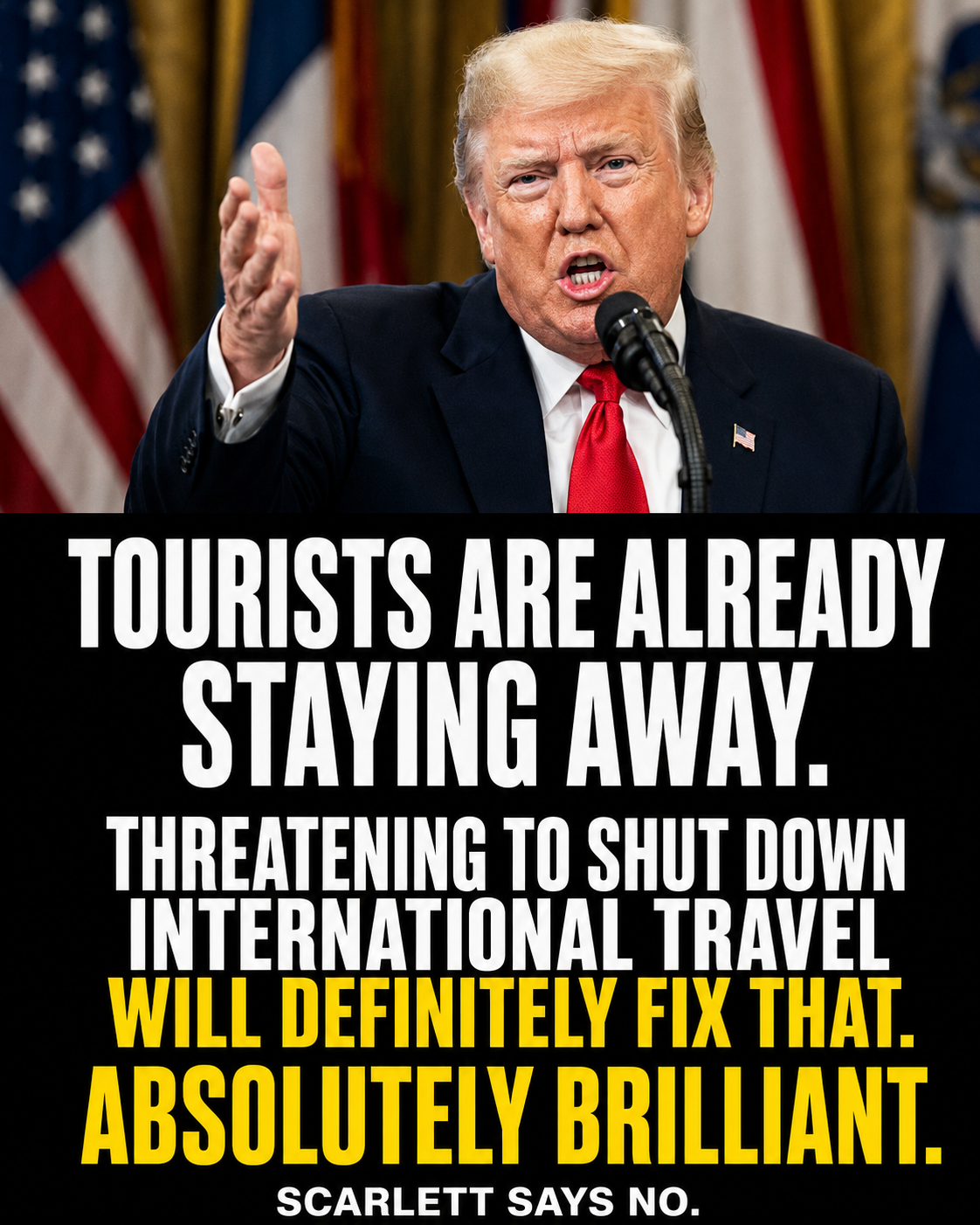
    The rest of the world kept traveling in 2025.

    Eighty million more people took international trips.

    But visits to the United States fell 5.5%.

    International visitor spending in the U.S. dropped 4.6% to $176 billion.

    Meanwhile, the global tourism industry had its best year ever, contributing a record $11.6 trillion to the global economy.

    The world moved forward.

    America went backward.

    What in the flipping hell is that?

    This Is Not Just About Vacations

    Tourism means jobs.

    It means hotel rooms, restaurant meals, museum tickets, local shops, rental cars, and money flowing into communities across the country.

    International travelers spend more, stay longer, and support businesses across the United States.

    When fewer people visit, American workers and small businesses pay the price.

    Hostility Is Not a Tourism Strategy

    Travelers have choices.

    They can spend their money somewhere that feels safer, calmer, and more welcoming.

    You cannot spend years treating outsiders like enemies and then act shocked when fewer people show up with suitcases and credit cards.

    That is not “America First.”

    That is self-sabotage wrapped in a flag.

    The world kept traveling.

    Fewer people chose us.

    Maybe it is time to ask why.

    Scarlett says no.